
The world of work is changing. Is Canary Wharf ready?
A host of buildings will require renovations to attract new tenants as major occupants depart


Vacancy rate (%)
0
1-25
26-50
51-75
Empty for redevelopment



Hidden scroll
Canary Wharf is entering a new era. As key tenants depart, millions of square feet of London office space is becoming available as landlords face up to a world of hybrid working.
The crux of the challenge facing Europe’s best-known office district is not just the space vacant now, but the number of buildings that are due to empty out over the next few years.
Tenants including HSBC and Clifford Chance are returning to the City of London after decades in the Docklands. Others, such as Barclays and Morgan Stanley, have decided to stay but reduce their footprint.
The situation reflects the difficult realities of the $4.5tn global investment market in offices following the Covid pandemic. The big question is how Canary Wharf will adapt, and at what cost.
The shimmering Canary Wharf estate began rising from east London’s derelict Docklands in the late 1980s to provide London with a modern office district.
The regeneration project was championed by then-prime minister Margaret Thatcher and became a symbol of the rise of UK financial services after the “big bang” reforms to the City of London.
The first tenants moved in from 1991, with most major banks ultimately decamping from the City.
It has been through previous downturns. A precursor to CWG went bankrupt in 1992, and the estate lost Bear Stearns and Lehman Brothers during the financial crisis — with JPMorgan taking Lehman’s tower.
Today’s difficult transition period was baked into Canary Wharf from the beginning. The banks that took the lion’s share of the wharf’s original offices did so typically on 25- or 30-year leases, often in several buildings.
Three decades later, those long leases are coming up to their expiry dates and the first cluster of buildings, conceived in the late 1980s and early 1990s, have reached an age when everything from windows to elevators and air conditioners will need expensive upgrades.
Over the years, Canary Wharf Group (CWG), the developer and management company of the estate, has sold off dozens of buildings — leaving it as the owner of just 13 of the 32 main office blocks. Other landlords include Blackstone, Kuwait state investment vehicle St Martins Property Group, Oaktree and Singapore’s GIC.
The challenge posed by empty buildings in the Docklands mirrors the predicament of landlords across Europe and in big cities around the world. In both New York and Paris’s La Défense, about 15 per cent of offices sit empty.
CWG’s reported vacancy rate was 9 per cent in 2023 — close to the London average — up from just 3 per cent in 2019.
But vacancy rates quoted in the real estate industry commonly exclude empty buildings that are set aside for renovation, where the landlord is not looking for new tenants. The total amount of space that is vacant or empty for redevelopment amounts to 21 per cent of CWG’s office portfolio.
Across the wider estate, more than a fifth of offices are also either vacant or empty for redevelopment. And the coming wave of office leases expiring amounts to at least 4.2mn sq ft over the next five years, around a quarter of the whole estate, according to FT analysis of data from CoStar, a real estate data and analytics service.
When CWG last week unveiled the first designs for a radical overhaul of 8 Canada Square, the tower HSBC will leave by 2027, it marked the first major step in laying out a strategy to tackle the sequence of huge buildings that will require vast and expensive renovations to attract new occupants when their current tenants depart.
CWG said it was confident it could maintain its renewal rate for office tenants at around two-thirds, and that its plans to revitalise the estate are working.
“I think we’re going to run out of space, I really do,” said John Mulqueen, CWG’s chief investment officer. “I have seen it so many times in my career. It doesn’t take very many deals.”
But navigating London’s second financial centre through this transition is fraught with risks. Repurposing projects such as the former HSBC tower are among the largest ever attempted.
People with knowledge of the situation estimate this project alone could cost £400mn-£800mn, although they cautioned that it was difficult to predict the cost of construction work that will run from 2027 to 2030.
The line-up of similar projects is daunting. Citigroup and Barclays are each working on less-radical upgrades to their towers. Clifford Chance’s tower, where the law firm’s main lease expires in 2028, is equally vast. Nearby 33 Canada Sq and 10 Cabot Sq are each about half as large.
Investors will have to commit huge sums to breathe fresh life into these buildings with little certainty that their plans will pay off. Independent valuers slashed the value of CWG’s offices by £900mn to £4.3bn in 2023.
“When you picture the problems of the office market, you picture Canary Wharf,” said one senior London property adviser. “It’s ground zero of all of the problems facing offices right now in less than one square mile.”
The bad luck of the pandemic and the rise of working from home, along with a tough economic environment for commercial property because of high debt costs, have added to the current challenges.
The large, American-style buildings that first attracted banks are increasingly out of fashion — and the City now offers competitive modern properties.
“Canary Wharf and La Défense are the two [office] districts in Europe that are probably most similar to the big traditional US office market that has been whacked so severely that people can't really look past that at the moment,” said one investor with direct experience of Canary Wharf. “Hopefully that will change.”
CWG’s leadership has spelled out a vision for the estate as a fully fledged neighbourhood with a buzzy mix of restaurants, parks, shopping, sports facilities, homes and workspaces for a range of businesses.
Mulqueen said the negative perception from some of Canary Wharf as “an unwelcoming and very secure fortress for financial services” was “outdated and uninformed”.
The estate is lively. Workers queue up for food stands on the plazas at lunch time. Tourists leaf through their guidebooks on benches in its freshly landscaped parks. A group of cheerful children from the local nursery are led through streets that were once the preserve of blue-suited bankers. The underground mall is packed, and the Waitrose is the biggest and busiest in the country.
But overhead, the looming office towers are a reminder of the work Canary Wharf still needs to do.
Scaffolding already covers parts of Citi’s tower. Morgan Stanley will be next, after agreeing with CWG that the landlord would put £150mn towards a renovation, equivalent to about £300 per sq ft. The total cost will probably be higher.
Key office buildings in Canary Wharf are in line for major refits

Support from CWG’s owners — Canadian investment group Brookfield and the Qatar Investment Authority — will be crucial for the landlord.
“Obviously there is going to be a lot of investment needed to get those assets turned around and relet,” said Euan Gatfield, managing director at Fitch Ratings. “There is definitely a complex 3D chess [game] going on in the background for Canary Wharf — between leasing, spending and their debt.”
Last year, the two owners injected £300mn — the first new equity they have put in since buying the group for £2.6bn in 2015. The funding has helped CWG to refinance key debts, and Brookfield and the QIA have pledged to put in more money if needed.
The QIA is also facing large bills for buildings that it owns in the wharf but outside of its CWG stake — including 8 Canada Sq, which it bought for £1.1bn in 2014.
At present it would probably be almost impossible to sell either individual office buildings or their CWG stake without a huge discount.
“Canary Wharf is a unique asset with incredible potential for long-term value,” Brookfield said. “We’ve witnessed successful urban transformations in the past and are dedicated to supporting Canary Wharf's next chapter.”
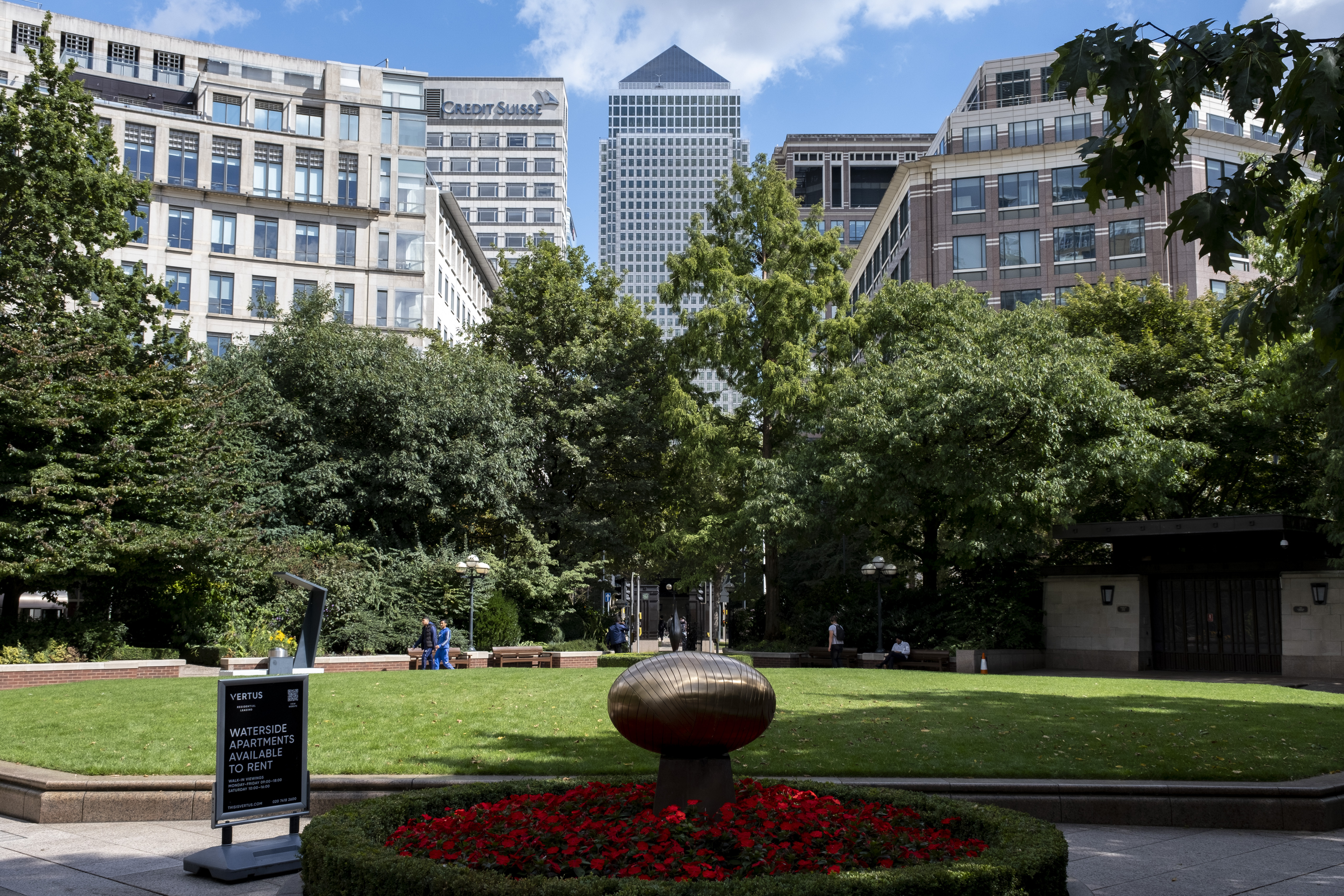
The levels of vacancy in Canary Wharf are likely to get worse before they get better. Parts of CWG’s portfolio are already empty. Key banking tenants have been consolidating since before the pandemic, and the increase in working from home, in an effort to cut costs.
Both Barclays and Morgan Stanley have given up smaller buildings and extended their stays in their main towers. Barclays paid CWG £310mn to get out of its lease on 10 Cabot Square, a large block on the estate’s main square. At 15 Westferry Circus, which Morgan Stanley gave up, CWG has told the remaining tenants it plans to revamp the building.
Banks at one point occupied many of Canary Wharf’s office blocks, but have committed to staying in just a few flagship towers


Citi and JPMorgan each own their main tower. Citi in 2022 committed to a makeover of the building it bought for £1.2bn in 2019. During the renovation, Citi is using two nearby buildings — space that will return to the landlord when Citi finishes the work around 2026.
Other long-time tenants are leaving entirely.
Credit Suisse staff have largely moved into their new owner UBS’s space-age premises in the redeveloped Broadgate Circle in the City. UBS has not yet finalised its plans for the Canary Wharf buildings, which are leased until 2034.
Law firm Clifford Chance is also heading back to the Square Mile. It leaves behind a 1mn sq ft renovation project at 10 Upper Bank Street — majority owned by China Life with QIA and CWG as minority investors.
Of all the companies to leave, though, it is HSBC that symbolises Canary Wharf’s struggle to retain its traditional financial tenants.
The tower was purpose-built for the bank, which relocated from the City in 2002. But it has decided to return there by 2027.
Architects Kohn Pedersen Fox recently won a global contest to reimagine the building with designs that take large chunks out of the facade to create new terraces and sections that will be easier to lease to a range of smaller tenants. These could be offices, or possibly a hotel or university, alongside shops, restaurants and entertainment venues.
Another flagship building, One Canada Square, already hosts a mix of offices for financial services, start-ups, co-working and education groups. Tenants include Brookfield and University College London.
Beyond the tenancies handed back to landlords, almost 900,000 sq ft — about 5 per cent of Canary Wharf office space — was available to sublease as of April, according to CoStar. CWG said this was a similar rate to other markets.
Another 400,000 sq ft of office space across the estate is let to flexible workspace groups. How much of that space is actually tenanted day-in, day-out is not clear.
CWG has been working for years to get ahead of this shift by refreshing its roster of financial tenants, signing up SocGen and the European Bank for Reconstruction and Development, which moved from the City. Luring more higher education institutions to the wharf, or signing up PwC — which is contemplating an office move — would be a big prize.
It has also been diversifying the estate. Some 3,500 people now live there, up from zero in 2020, which CWG hopes to double in the coming years. Thousands more apartments, serviced flats and student residences are under construction in Wood Wharf. The push into residential property has defied naysayers who did not think people would want to live in the wharf.
CWG has invested in residential properties, with more housing under construction

Under Shobi Khan, who took over as CWG’s chief executive in 2019, the company has set out a strategy it calls Canary Wharf 3.0. The district’s first iteration was as an office campus — mostly for a few big financial groups — and the second phase from 2015 primarily involved adding homes into the mix.
In its third generation, Khan wants Canary Wharf to be greener and more lively, which will make it both a more attractive place to work and less reliant on offices. It has added more entertainment attractions, such as a go-kart track and open water swimming, and almost doubled the number of cafés, restaurants and bars in its portfolio.
These attractions brought in a record 67mn visitors last year, according to CWG. Public transport journeys to the district are back above 2019 levels, according to Transport for London data. Retail rental income grew 20 per cent to £68.5mn in 2023 from the year before.
It is not clear how far these new uses can substitute for the millions of square feet of traditional office space falling vacant over the next five years. CWG still derives 50 per cent of its underlying revenue from office rents.
Converting office blocks can potentially bring more demand and higher rents, but also costs more than simply freshening up an office.
Large office towers are often almost impossible to convert to residential use because their floors are too big to divide easily into apartments.
CWG has bet heavily on attracting life sciences companies to the estate. It is building a new 23-storey science building with lab specialist Kadans, intended to anchor a cluster of these high-tech businesses.
The ability to switch over office buildings to life sciences workspaces depends on complex factors such as ceiling heights, ventilation and how much buildings sway and vibrate — and costs at least 25 per cent more than an office facelift.
Taking the cheaper option and sprucing up offices to modern specifications does not guarantee they will be immediately leased.
Thirty South Colonnade, once known for its Reuters news ticker, has now been rebranded as the YY Building after a full refit by investors Oaktree and Quadrant. But the building has taken years to lease. Its first tenant, fintech Revolut, is expected to move in soon.
Investors are wary of buying into Canary Wharf. “There are no buyers for relatively large floor plate office buildings in Canary Wharf at the moment,” the investor with knowledge of the Wharf said.
A deal to sell the former Bear Stearns building, one of two blocks to fall into receivership last year, collapsed despite the 60 per cent discount to its 2017 price. Blackstone also pulled the sale of its remaining block in the wharf after being unable to get an acceptable price.
But CWG has this year secured backing from lenders for a £553mn refinancing package, including a major office loan, something chief financial officer Becky Worthington said showed “the strength of our assets . . . and the support we have from our lenders for our long-term plan”.
Although it faces a long and expensive transition, there are many who believe Canary Wharf will bounce back.
High debt costs and the uncertain office market have led developers to slash their plans for new buildings across London. Office brokers warn that fewer new or freshly renovated spaces will be available over the coming years, and prime office rents are climbing in the City and London’s West End.
CWG’s Mulqueen said he thinks the line-up of buildings being refreshed would be ready for a return of demand and will benefit from short supply from other developers in a few years’ time.
“I think it is great to have these buildings coming back at this time. I think it’s perfect timing for the market. We are going to see occupiers wanting buildings and nothing coming to market,” he said. “There is an idea of constructive vacancy, where you are actively seeking vacancy because you have a plan.”
Adam Shapton, analyst at Green Street, said: “If you wanted to be positive about Canary Wharf, one thing is how little good quality space there is available in the City. There is a sense of the traditional release valve where, when rents get too high or availability gets too low in the City, people go to Canary Wharf.”
Citadel agreed to pay £98 per sq ft for its mammoth pre-let in British Land’s new building near Broadgate. That compares to about £65 per sq ft for top quality space in Canary Wharf.
But Shapton added that companies were currently less sensitive to their rental costs. “Post-pandemic era, occupiers tend to think less about saving 20 per cent on rent and more about making your staff want to come into the office.”
While it seeks to prove that it can deliver a new life for old buildings within the development, CWG has put its pipeline of office construction on ice.
Its plans for Wood Wharf allow for up to 1.8mn sq ft of offices in four buildings, which the company says it has no plans to progress until it lines up tenants.
At 10 Bank Street, it has completed the basement works for a new 800,000 sq ft tower. It is the type of vast office project that has been CWG’s calling card. But with no tenant on the horizon for such a building, they are putting the land to a different use. The worksite has been capped off, with padel tennis and basketball courts installed on top.
Data on office vacancy and lease expires as of April 2024 from CoStar, which has been analysed and updated by the FT to reflect recent changes.
CoStar data has unknown lease expiries at 1 Canada Sq and 50 Bank St. Co-working space is treated as fully occupied. JPMorgan owns its main building, which is treated as fully occupied for the long term. Citi also owns its building, which is treated as empty for redevelopment. Space temporarily occupied by Citi is counted within the leases expiring within five years. Two buildings have space that is counted as both vacant and available for sublease.