How China’s lockdown policies are crippling the country’s economy
After months of rolling lockdowns in scores of Chinese cities that have forced hundreds of millions of people to remain in their homes, it is clear that President Xi Jinping is prepared to pursue his policy of zero-Covid at the expense of all other concerns.
That includes the widespread damage the policy is wreaking on the world’s second-biggest economy and most important manufacturing engine, and the political risks it is creating by further limiting the freedom of 1.4bn people.
Chinese leaders have long believed they can bend nature to their will. Sixth-century Sui emperors and later Mongol rulers harnessed the Yangtze and the Yellow rivers via their 1,000-mile-long Grand Canal.
In the 1950s, Mao Zedong demanded rats, flies, mosquitos and sparrows be eradicated. Deng Xiaoping’s one-child policy, introduced in the 1980s, imprinted state control on women’s reproductive rights.
Now Xi, the most powerful leader in a generation, is battling another force of nature as he tries to keep the world’s most populous country free of Covid-19.
Xi and the Chinese Communist party must project stability and strength before November, when the 68-year-old leader will cement an unprecedented third term in power. But Xi is caught between confronting an unparalleled health crisis and risking becoming the first leader in almost five decades to witness China’s economic growth fall behind that of the US.
For two years the zero-Covid playbook — mass testing, rapid fire lockdowns, travel bans and locking people up for weeks in state quarantine — was deployed with ruthless efficiency. And it was, by many metrics, a great success. As of May 30, China’s official death toll from the pandemic stood at 5,226, compared with more than 1mn in the US and 179,000 in the UK.
But now Xi’s contentious policy has brought business activity to a halt in Shanghai, China’s largest city, as well as swaths of Beijing and dozens of smaller municipalities, mostly in the east of the country. So what went wrong?
Enter Omicron. On December 14, China reported its first case of the highly transmissible new variant in the northern port city of Tianjin. Crisis loomed. The much anticipated Winter Olympics, a prestigious event for Xi, was just two months away.
Residents in Tianjin are taken to quarantine camps in May — five months after the city first recorded a case of Omicron. Twitter: @Byron_Wan
Days later, in what could now be read as a forerunner of what was to come in 2022, Xi’an, in central China, was sealed off from the outside world and its 13mn people locked down for city-wide testing.
The Beijing Winter Olympics went ahead but were overshadowed by athletes trapped inside a so-called closed loop, guarded by hordes of officials in white hazmat suits.
Yet just as the games closed and the world’s attention switched to Russia’s invasion of Ukraine, Chinese authorities tightened border restrictions, extended isolation periods and rapidly expanded state quarantine facilities across the country.

The Beijing Winter Olympics was held in a “closed loop” to keep the 11,000 visitors apart from the Chinese population. © Tyrone Siu/Reuters
Further small outbreaks — measured mostly in double digit case numbers — sparked snap lockdowns in dozens of cities. In most cases the populations emerged within days or a few weeks.
Confidence — perhaps hubris — that the zero-Covid tactics would beat off Omicron grew after an outbreak in Shenzhen in March. The city, the world’s high-tech workshop building products for Apple, Microsoft and Samsung, swiftly stamped out the outbreak and its 17.5mn people were allowed out of their apartments after seven days.
By the middle of March the country’s tally of Omicron cases had grown to 5,000, low by international standards but reflecting a tenfold increase in just two weeks.
The industrial and agricultural hubs of Jilin and Changchun, along the country’s northern rustbelt, were also among those locked down.
Yet when Omicron swept into Shanghai in March officials were initially given a long leash by Beijing; businesses could stay open, and on March 23, the city’s leaders dismissed reports of a looming lockdown as “rumours”.
The localised lockdowns in the eastern districts of Shanghai quickly spread and merged together.
By April, more than two years after Covid first emerged in Wuhan, central China, millions of residents in both the east and west of the country’s wealthiest, most international and populous metropolis had become prisoners in their own homes. Some have been confined for two months or more, many struggling with their mental health and even more struggling to obtain basic essential goods.
9.8mn
Average daily subway traffic in Shanghai in 2021
0
Number of subway trips on May 22
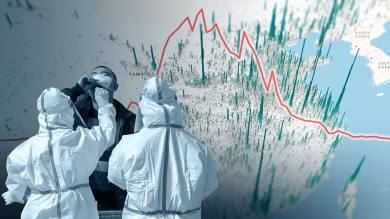
Dystopian scenes involving an army of officials and volunteers in white hazmat suits became commonplace: storming apartments, breaking down doors, or using long metal rods with claws to capture quarantine-bound people; disinfecting empty streets; killing pets over fear of infection.
Health workers attempt to push residents through the street using metal prongs. Twitter: @fangshimin
Authorities have also turned to technology to maintain order. Robot dogs roam the streets and corridors of apartment complexes, barking orders for people to wash their hands and check their temperature. Where the dogs can’t go, drones are flown in to further admonish residents for transgressions.
Robot dogs broadcast messages telling residents in Shanghai to stay at home. Twitter: @JayinShanghai
The crackdown has sparked angry discussions over the wisdom of the ruling Communist party and Xi’s administration. At street level, those criticisms are mostly directed at local authorities for their bureaucracy and heavy-handed treatment of residents.
In some corners, the police and other officials who compose the bulk of the hazmat army, the so-called da bai or big whites, are now called “white guards”, a nod to the murderous red guards of Mao’s Cultural Revolution.
In countless incidents across China frustrated residents have clashed with local officials — usually verbally, but physical encounters and isolated protests have also flared, such as in the Zhangjiang Nashi International Community estate in the Nanhui district.
A quarrel breaks out between health workers and residents after Zhangjiang Nashi International Community estate in Shanghai is taken over for quarantine use. Twitter: @Jerry00107966
While Shanghai’s caseload has slowly fallen and state media has touted a return to freedom, millions of people remain under lockdown.
Video footage of a near-deserted stretch of the 5.5km-long Nanjing Road in early May, China's premier shopping street — and usually one of the world’s busiest — highlights how desolate the city’s streets have been.
A deserted stretch of Nanjing Road in May. Twitter: @sunfa88
Similar episodes have been playing out in the capital, Beijing, for weeks. There has been no announcement of a formal city-wide shutdown yet, but day after day new districts fall victim to lockdown measures.
Beijing’s slow, rolling lockdown shows that until there is a significant change in direction from the very top — from Xi Jinping himself — every building, compound, suburb, district and city in China remains susceptible to being sealed off without notice.
8.4mn
Average daily subway traffic in Beijing in 2021
0.8mn
Number of subway trips on May 22
The country’s clearest gauge of consumer activity, national retail sales, fell 11.1 per cent in April from a year earlier — twice as much as most economists’ forecast.
Across southern China, the heart of the global technology supply chain, logistics networks have been choked by ever-changing restrictions on travel and factory closures.
Companies have tried to adapt. In Shanghai, Elon Musk’s electric carmaker Tesla has joined throngs of businesses demanding workers live on site under a “closed loop” system at its giga factory on the city’s eastern edge — a remarkable move by a billionaire who lambasted American lockdowns as “fascist”.
Output and profits from Chinese factories in April swung into reverse for the first time since the initial wave of coronavirus in early 2020. And unlike late 2020 and 2021 when Chinese shoppers diverted some of their annual $250bn offshore tourism spend to local travel and shopping, this time far fewer people are engaging in non-essential spending.
The bleak outlook, exacerbated by rising inflation after Russia’s invasion of Ukraine, means that a repeat of China’s 2020 export-led recovery, buoyed by domestic consumption, is less likely.
The deteriorating conditions have divided Chinese society and sparked rare criticism of the government from the middle class and some business leaders, including the usually reserved Pony Ma, founder of social network giant Tencent. Yet the worst affected are the hundreds of millions of voiceless, low-income migrant labourers.
Around Beijing, the pain caused by the zero-Covid strictures is palpable. Food markets, construction sites and shops are shut down and workers cannot move between districts.
“The neighbourhoods don’t let us in. The market is closed. There is literally nothing we can do until the pandemic ends”, says Du, a labourer in the central Chaoyang district, who would only give his surname.
At a vegetable market in Miyun, on the city’s north-east edge, a man in his fifties complains that despite bouts of panic buying — often sparked by rumours of even stricter lockdowns — business has deteriorated, with slow sales and vendors frequently harassed by local authorities over pandemic controls, at times even forcing them to close their stalls.
A cleaner working in a canteen at Beijing’s prestigious Tsinghua University, whose name has been excluded to protect their safety, feels trapped. Some students have protested against restrictions that kept them inside campuses. The cleaner, 58, who is from a rural farming family in the northern Heilongjiang province, has no choice but to accept orders to sleep on the floor of the canteen, unable to leave the campus.
“We don’t get beds,” they say. “They haven’t told us how long we’ll stay here.”
Students at Peking university — ranked the top academic institution in China — have also been filmed protesting against quarantine rules.
Peking University students protest against the quarantine rules. Twitter: @MJTVHoPin
Faltering growth has accelerated youth unemployment, which in urban areas has jumped from 14 per cent late last year to 18 per cent today, and on a national level has overtaken Europe, according to Statista and official data.
More worrying for Xi and his economic planners is the impact on China’s property market, which usually accounts for almost a third of the economy.
Key national indicators in April such as new home sales, property investment and house prices are all lower against a backdrop of consumer pessimism. Meanwhile, private sector corporate defaults have risen and corporate investments levels are declining.
Few predicted the severity of the economic fallout from the lockdowns. But as the pain mounts, economists have slashed their forecasts for China’s economic growth this year. Beijing’s goal of 5.5 per cent, already its lowest target in three decades, looks increasingly ambitious.
China’s premier Li Keqiang last week warned more than 100,000 officials that the economy would struggle to grow this quarter. If it contracts — as it did in the first quarter of 2020 during the initial Covid outbreak — that would mark only the second three-month period of negative growth for China’s economy in the past 30 years.
Economists also warn of a snowballing impact beyond China. Its economy had been expected to continue to drive about one fifth of all global gross domestic product growth until at least 2026. But Li’s warning came a day after he announced 33 new policy initiatives to try to halt the decline, including reverting to traditional stimulus measures such as spending on large-scale infrastructure projects, offering tax breaks and easing restrictions on banks to increase lending.
While the measures have injected some confidence amid pressure on China’s markets and currency, they might not benefit the country’s most vulnerable, experts say.
“If you’re putting a lot of money into infrastructure, that’s okay, but those are not going to substitute [for] the jobs lost in the services sector in the coastal cities,” says one Beijing-based economist, adding that corporate tax relief is of little value to a massive informal migrant workforce.
Beijing’s knee-jerk moves also carry longer-term systemic risks.
“Forcing banks to expand lending can accommodate an increase in productive investment only if there is pent-up demand from businesses for credit,” says Michael Pettis, a finance professor at Peking university. “If businesses aren't investing because demand for their products is weak, forcing banks to expand credit to them will only feed the wrong kind of credit.”
The cost of implementing Xi’s healthcare policies — including the need to purchase huge supplies of PCR kits for mass-testing campaigns — is also weighing on China’s cash-strapped local governments. This has been felt in cities from Jilin in the north-east to the southern industrial hub of Quanzhou, where officials have been compelled to reallocate funds earmarked for poverty alleviation programmes.
Dozens of cities and provinces are turning a blind eye to labour violations, including forcing employees to work dangerously long hours to boost the economy. This has happened in eastern Jiangsu province, bordering Shanghai, as well as Zhangzhou, in south-eastern Fujian province.
“There are vigorous debates going on behind closed doors about when and how China should make a strategic shift,” says the Beijing economist. “The problem is: can you get to zero Covid? It is a strategy that in light of the recent evidence looks less implementable than in the past.”
Over recent days case numbers have declined and some restrictions have been lifted in parts of Shanghai and Beijing. But nationwide more than 130mn people remain under full or partial lockdown in at least 16 cities, according to Nomura data.
Xi’s unflinching commitment to his zero-Covid policy is grounded in a simple fear. In May, researchers at Fudan University sounded the alarm: left unchecked, Omicron outbreaks across China could kill 1.6mn people in three months, they found.
From Xi’s point of view, not only could a fast-transmitting coronavirus overwhelm the country’s hospitals and mortuaries, but it could also ultimately erode trust in the ruling Communist party and its leader.
As of May 30, China had delivered 3.4bn vaccine doses domestically. Yet failings in the national roll out programme mean that 36 per cent of those aged over 60 are under-vaccinated and vulnerable — that is 96mn people. The roll-out was already struggling due to deep-seated vaccine hesitancy among China’s elderly. But the reallocation of frontline healthcare resources back towards mass testing in response to the Omicron wave, has exacerbated the problem.
According to a Financial Times analysis, if China continues to administer jabs at the current rate of 250,000 a day it will take until March 2023 before 90 per cent of the elderly population completes a three-dose vaccination course.
While the Chinese-made jabs are less effective than western peers, they are good enough, says Ben Cowling, a professor of epidemiology at the University of Hong Kong and co-author of a study that found that three Sinovac doses were 98 per cent effective at preventing severe illness in people older than 60.
The greater challenge for Beijing is accepting that even very high vaccine coverage will not stop the spread of Omicron — or future, more transmissible variations.
And while there are gaps in vaccination coverage, there remains a “serious threat” not only to the unvaccinated elderly but also “people of all ages whose healthcare would be disrupted because hospitals are overflowing”, adds Cowling.
David Mahon, a western businessman based in Beijing since 1985, says that despite zero-Covid’s historic echoes from China’s earlier attempts to tame nature, the leadership in Beijing “cannot be deaf” to the fact that Omicron cannot be completely controlled.
So is an exit possible? This autumn Xi will enter the Great Hall of the People adjacent to Beijing’s Tiananmen Square and use a twice-a-decade party congress to cement his third term as leader, setting him up to rule for life.
The conventional wisdom among analysts and China watchers — even begrudgingly among Xi’s defenders, many of whom are locked in their apartments — is that no course change on zero-Covid will happen before the party congress concludes and Xi’s future is settled.
Juxtaposed with failing healthcare systems and high death tolls in the US and UK, the Chinese system has clearly been superior, according to the country’s leaders and Communist party propagandists.
“China will surely win the war against Covid-19,” vowed Xi at a meeting of the party’s 7-member Politburo Standing Committee, its most powerful body, on May 5.
Relaxing the controls, he conceded, would “undoubtedly lead to massive numbers of infections, critical cases and deaths”.
“Our prevention and control policies can withstand the test of history . . . We have won the battle to defend Wuhan, we can also win the battle to defend Shanghai,” Xi said at the time.
But experts warn that if economic conditions worsen and social controls are further tightened, discontent could undermine faith in the Chinese leadership.
“To the extent that the zero-Covid policy has left people — especially the most marginalised — weak, starving and jobless, popular anger may continue to mount,” says Diana Fu, an expert on China’s domestic politics with the Brookings Institution. “In the absence of legal and procedural safeguards [to] protect the most vulnerable during a time of crises, the law of the jungle prevails.”
Additional reporting: Maiqi Ding and Arjun Neil Alim in Beijing and Eleanor Olcott in Taipei.
Additional development: Sam Learner in New York.
Note and sources: Data on national and regional numbers of confirmed cases from China National Health Commission. The list of cities under lockdown from Goldman Sachs. China’s economic figures fromNational Bureau of Statistics of China. Subway traffic numbers from MetroDB.org.
Elderly population vaccination figures based on reports by China National Health Commission and FT calculations. Vaccination rate in East Asian countries from China National Health Commission, Prime Minister’s Office of Japan, Ministry of Health of Singapore and Ministry of Health of New Zealand.
Map data for cities and districts from geojson.cn and poi86.com. Population data from the Global Human Settlement Layer and analysed in 5km by 5km grids. Peking campus map from Peking University. Tsinghua campus map from Tsinghua University.