

A sleek electric aircraft in the familiar blue and white livery of United Airlines is ready to go. It takes off vertically, rising above clogged city streets, whizzing towards the Manhattan skyline.
This is just a marketing video with CGI animation for now, but United and Archer Aviation, an air taxi start-up, say it will be a reality in two years, with a four-seat vehicle flying regular shuttles between the airline’s hub in Newark and downtown New York. The companies say the journey, which can take more than an hour by car or public transportation, will take 10 minutes and cost about $100 per passenger.
Companies around the world are closing in on the dream: a battery-powered aircraft — the industry dislikes the term “flying car” — that takes off and lands like a helicopter, cruises like a plane and is blessed by regulators for commercial use. Backers include big names such as Boeing and the automaker Stellantis, and several companies are targeting 2024 or 2025 for entry into service.
Yet the journey to build, certify and fly such an aircraft remains expensive, uncertain and competitive. Industry estimates peg the cost of developing one through to certification at roughly $1bn. Those who succeed will have to demonstrate both technological capability and sufficient capital and give regulators enough confidence to certify their aircraft as safe. Then they need to price their offering at a level that will convince the public to get onboard.
Proponents of electric aircraft promise travel that is free from the earthbound traffic snarls that have blighted modern cities. But there will be challenges, such as building the necessary infrastructure, ensuring quiet operation in crowded cities, and winning public acceptance.
“We are going to have a vehicle that has great utility to fly people 50-mile and less trips,” says Mike Leskinen, president of United Airlines Ventures, the airline’s venture capital arm, which has backed Archer.
“The bigger question is, how do we get the FAA [Federal Aviation Administration] to certify, how do we make sure that [air taxis] have the same safety level as commercial aircraft, how do we integrate that into congested air traffic control and congested airspace? Those are the bigger gating items than, ‘is the aircraft capable?’”
“It’s going to be life-changing,” he adds. “It’s a matter of when, not if.”
After years of promise and missed milestones, the industry is nearing an inflection point. The coming 18 months will be critical as several contenders ramp up the flight test programmes crucial to gaining regulatory certification, putting their resources under strain. Some may have to tap investors again before launch at a time when much of the recent enthusiasm for technology stocks has evaporated. Others may not clear the regulatory hoops. In a crowded field, not everyone will survive.
“The people that are really pushing this air mobility concept are visionaries,” says John Cox, an aviation safety expert and former airline captain. “They're very futuristic, and . . . there is some naivete there.”
The visionaries, he adds, are about to meet “the cold, hard reality of our national airspace system and the national safety regulations, and that merger is going to be challenging.”

Some of the contenders
The idea of flying taxis has been around for more than a century. In 1926, Henry Ford unveiled the Ford “Flivver”, a flying car for the masses that was supposed to do for aircraft what the Model T had done for cars. It failed to enter production after a fatal test flight. There have been other examples along the way.
The main players today are spread across the US and Europe, with contenders also located in China and Brazil. Some are start-ups, others are backed by industry incumbents such as Airbus, Boeing and Embraer. Boeing, which recently became the sole owner of California-based Wisk Aero, will be showing off the company’s latest generation vehicle at next week’s Paris airshow.
Each of these vehicles will need to be certified by regulators in their home country, but unlike with traditional aircraft, that does not guarantee they will be declared safe to fly in other regions.
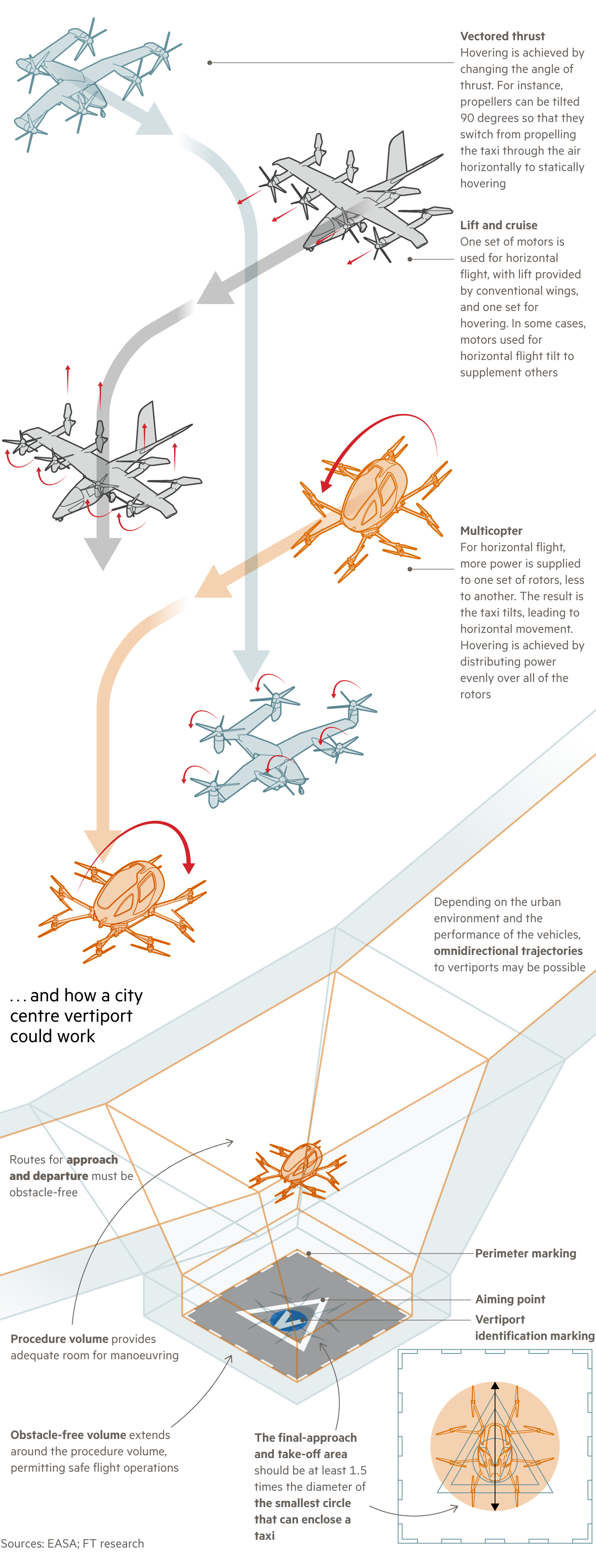
The companies planning to introduce electric vertical take-off and landing aircraft (eVTOLs) within three years have adopted three vehicle types: multicopters, vectored thrust and lift plus cruise.
Multicopters look the most like helicopters. They have no wings, fly a shorter range, are simpler to produce, and the industry views them as easier to certify.
The other two configurations combine rotors and wings. A lift-plus-cruise vehicle uses one set of rotors to lift into the air and another set to cruise to its destination. A vectored-thrust air taxi uses a single set of rotors: they lift the aircraft off the ground, then tilt to propel it forward.
Archer Aviation
| Model | Midnight |
| Type | Vectored thrust |
| Funding | $856mn |
| Passengers | 4 (plus pilot) |
| Range | 160km |
| Country | US |
| Launch | 2025 |
Archer Aviation was founded in 2018 by two former hedge fund analysts whose previous start-up was an online recruiting platform. It went public in 2021 backed by billionaire investment banker Ken Moelis. Archer started construction in March on a factory in Georgia and plans to begin production next year.
Archer’s Midnight model, built from aerospace parts already on the market, is scheduled to make its first test flight this summer. Co-founder Brett Adcock, who left Archer last year, said in 2021 that it would launch in 2024, but the company now says it expects to begin operating in 2025.
Airbus
| Model | CityAirbus NextGen |
| Type | Lift plus cruise |
| Funding | Parent company |
| Passengers | 3 (plus pilot) |
| Range | 80km |
| Country | Germany |
| Launch | 2025+ |
Europe’s Airbus has much deeper pockets than the start-ups. It has experimented with several concepts but says it is not competing with other models, nor trying to set records; it wants to develop something that could be another business pillar for Airbus.
The CityAirbus NextGen is the product of the development of two very different demonstrators, the multicopter CityAirbus and the tilt-wing Vahana. It has fixed wings and a v-shaped tail, as well as eight electric-powered propellers.
Ehang Holdings
| Model | EH216-S |
| Type | Multicopter |
| Funding | $142mn |
| Passengers | 2 (no pilot) |
| Range | 30km |
| Country | China |
| Launch | 2023 |
Ehang is building an autonomous aircraft that will not need a pilot. Unlike most of the companies that plan to operate an air taxi service, Ehang plans to sell an aircraft built for tourism, firefighting or emergency medical services.
Executives told investors last month that the EH216-S has completed “90 per cent” of the criteria for obtaining a type certificate from China’s civil aviation administration. The company’s chief financial officer previously said it would begin operating in 2022. Special permits in China allow the company to fly in some areas even though it has yet to be fully certified.
Joby Aviation
| Model | JAS4-1 |
| Type | Vectored thrust |
| Funding | $2.1bn |
| Passengers | 4 (plus pilot) |
| Range | 240km |
| Country | US |
| Launch | 2025 |
Joby Aviation was founded in 2009 and in its infancy operated out of a barn on the California property of its founder. It has Silicon Valley ties, with the co-founders of Pinterest and LinkedIn sitting on the board. In 2021, it acquired Uber Elevate, the flying taxi arm of the ride-hailing company.
The vertically integrated company engineers its own specialised parts for the S4, which it said is more costly but improves the final product and minimises delays from supply chain disruptions. Each plane, when operated as an air taxi, is expected to generate $1mn in earnings, according to a securities filing.
Vertical Aerospace
| Model | VX4 |
| Type | Vectored thrust |
| Funding | $384mn |
| Passengers | 4 (plus pilot) |
| Range | 160km |
| Country | UK |
| Launch | 2026 |
Founded by British energy entrepreneur Stephen Fitzpatrick in 2016, Vertical has pursued a partnership model. It has teamed up with Rolls-Royce and Honeywell to draw on their expertise and help speed up the path through certification.
The company claims its VX4 will be “extremely quiet” with a target of “less than 50 decibels in cruise”. It uses avionics based on the same flight control technologies as the F-35 fighter jet. It does not plan to operate the vehicle but to sell the aircraft to customers.
Volocopter
| Model | VoloCity |
| Type | Multicopter |
| Funding | $761mn+ |
| Passengers | 1 (plus pilot) |
| Range | 35km |
| Country | Germany |
| Launch | 2024 |
Germany’s Volocopter wants to be the first to fly commercially in Europe with its two-seat VoloCity as early as next summer, in time for the Paris Olympics.
The VoloCity multicopter has a distinctive halo, or beam, of 18 fixed-pitch rotors and 18 electric motors, all powered by nine lithium-ion battery packs. The battery packs can be swapped out in about five minutes.
Loading
While most of the companies are start-ups, many have collected well-known backers. Stellantis, the owner of Peugeot and Fiat in Europe and Chrysler in the US, has agreed to buy up to $150mn-worth of Archer’s stock while also manufacturing its model, the Midnight. United has paid $10mn toward a $1bn aircraft order.
Toyota invested nearly $400mn in Joby Aviation, making it the company’s largest investor, and Delta Air Lines contributed another $60mn. Volocopter has received backing from Daimler and Geely, while Vertical Aerospace has attracted investment from Honeywell and American Airlines. The UK company has also announced pre-orders from American Airlines and Virgin Atlantic.
Several of the start-ups, including Joby, Archer and Vertical, have tapped public investors, listing on US stock markets through special purpose acquisition companies, or Spacs. Joby has raised $2.1bn so far, the most money in the field, followed by Germany’s Lilium, with $1.2bn.
Unlike most of its competitors, Lilium hopes to lift off using electric jet engines embedded in four wings. The company has extended its certification date to 2025 and told investors in May that it was looking to raise a further $250mn. Eve Holding, which is controlled by Embraer, has raised $377mn and Wisk, $775mn. The aircraft being developed by Vermont-based Beta Technologies has also attracted significant investment, raising more than $796mn.
Investors’ enthusiasm for the stocks has deflated in the past two years amid increased economic uncertainty. All four trade at significant discounts to their listing price.
Aerospace is notoriously capital-intensive, but the amount raised matters less than how effectively the company spends it to advance towards certification, says Sergio Cecutta, founder of SMG Consulting, which tracks the advanced air mobility industry. Until one of these companies turns a profit, “the Grim Reaper is still on [its] tail”.


Clockwise from top left: Vertical Aerospace’s VX4, Volocopter’s VoloCity, Archer Aviation’s Midnight, Joby Aviation’s JAS4-1, The City Airbus NextGen and Ehang’s EH216-S ©️ Company press releases
Clockwise from top left: Vertical Aerospace’s VX4, Volocopter’s VoloCity, Ehang’s EH216-S, Joby Aviation’s JAS4-1, The City Airbus NextGen and Archer Aviation’s Midnight ©️ Company press releases
The technical challenges
The engineers designing the new aircraft must confront significant technical challenges.
The power required to take off and land vertically, which requires hovering, is greater than with winged flight. An aircraft that does both must make trade offs, and the difficulty of vertical takeoff and landing adds “a level of complexity and risk which seems to be underestimated by a number of stakeholders”, according to the European Union Aviation Safety Agency, or Easa.
Batteries are less energy dense than jet fuel, meaning electric aircraft cannot travel as far or carry as much weight. While the companies are using composite light-weight materials to help reduce weight, staying airborne in an electric aircraft consumes energy to the degree that, “at some point you’re carrying battery to carry battery, instead of people and payload”, says Farhan Gandhi, director of Rensselaer Polytechnic Institute’s Center for Mobility with Vertical Lift.
Batteries can also catch fire. There have been reports of at least two fires involving lithium-ion batteries for these electric aircraft, one involving batteries stored inside a shipping container.
The three configurations embraced by the industry’s leaders — multicopter, lift plus cruise and vectored thrust — all carry advantages and drawbacks, and “the jury is out” on which is best, according to Gandhi.
The regulatory landscape
None of these aircraft has yet been certified by an aviation regulator. In the US and Europe, each company will need to receive a “type certificate”, approving the design of the aircraft and its parts. They will also need certification to prove that the design can be mass-produced and, for those companies planning to fly their vehicle, official permission to operate as an air carrier.
In Europe, Volocopter has the most ambitious target, with plans to get its VoloCity vehicle certified by Easa as early as the second quarter of 2024. Vertical Aerospace obtained a preliminary approval in March from Britain’s regulator, the Civil Aviation Authority, or CAA.
In the US, Archer is shooting for certification by the end of 2024, and certification is “a horse race” between it and Joby, Leskinen says.
Easa is the only regulator so far that has published dedicated technical specifications for eVTOLs. As part of its “special condition for VTOL” specification, Easa has told developers planning commercial passenger flights to adopt the safety standard currently applied to commercial jetliners: the chance of just one catastrophic failure in 1bn flight hours. It envisages air taxis operating with a high frequency in large numbers and not only from current airports.
“We have to find the right balance on the safety target, because we know that the first crash will be very damaging not just for one operator, but for the entire industry,” says David Solar, head of general aviation and the regulator’s VTOL department.
The FAA has yet to specify a target safety level but would probably set the threshold at one catastrophic failure every 100mn flight hours, or 10mn flight hours. FAA officials say its approach is as safe as the Easa one, just philosophically different. “Redundancy”, or having a back-up, is at the heart of aviation safety and while European regulators want more back-up systems built into the plane itself, their US counterparts regard the pilot as an extra safeguard against disaster, particularly since an air taxi is mechanically simpler than a jetliner.
The differences could limit manufacturers’ ability to sell or operate their aircraft outside the region that certified them, at least at the start, damping profit expectations. US companies are looking to Japan, Canada and Australia, which are following the FAA. It remains to be seen whether Ehang’s automated design will be certified outside of China.
“These companies want to market their vehicles in more than one region,” says Kirsten Riensema, who oversees advanced air mobility at Britain’s CAA. “The more we harmonise, the better it is, both for the industry and for safety.”
Easa is working with the FAA to minimise differences in certification standards and ensure “minimum changes to the aircraft configuration” so that operators can fly in both regions, says Solar.

Function and safety
Exactly how air taxis will integrate into each city’s existing aviation ecosystem is a work in progress.
To offer a reliable service, air taxis will need the right infrastructure to land. Aviation regulators are working on the designs and standards of vertiports — unlike heliports, vertiports will probably have to be sized differently to accommodate a variety of vehicles. They will also have to offer electric charging ports.
Passengers will need somewhere to check-in. At the same time, city residents will need to be convinced that these vehicles will not only be quiet, but safe.
Aviation regulators have started working with local authorities to agree on “flight corridors” that air taxi operators will have to adhere to when they fly, both for safety reasons and to minimise their potential impact on the urban environment.
How flying taxis go from horizontal to vertical flight . . .
Operators will need to consider other factors, including noise, weather and ride quality. While one air taxi might not growl above the urban din, a swarm could be louder. The problem is “the bee versus the beehive”, says Cecutta. “You never hear a bee, but if you go next to a beehive, you’re going to hear it.”
These aircraft also will have limited range, notes Cox, the aviation safety expert. When they encounter poor weather, they will need enough places to land before their batteries are spent. Companies will need to map those alternate routes in advance.
“There are very serious and complex airspace issues that have to be resolved,” he says. “Say you don’t have three or four places to divert. How are you going to deal with it?”

Operations and cost
Some analysts predict that the market could still be worth as much as $1tn by 2040.
“We are not targeting this first air taxi market as our entry point,” says Balkiz Sarihan, head of urban air mobility at Airbus. There is still a “lot of maturation of the technology” that needs to take place, as well as the establishment of a “trust . . . with the people who are boarding this plane”.
For those promising fast, stress-free transport across shorter distances, they are pitching their product for passengers as comparable in price to a taxi and cheaper than a helicopter, while trying to balance the costs of development, serial production and operation.
“There is no question that you can build these. The question is, what is the economics,” says Alan Epstein, a former industry executive and professor emeritus at MIT.
Companies will need to build significant quantities of these vehicles in order to recoup their manufacturing cost, he adds, so “who puts up the money to lose on every unit made for the first five years of production?”
Archer chief executive Adam Goldstein says the aircraft will cost between $2mn and $2.5mn to manufacture at the start, falling to $1mn as the business scales. With fewer parts than helicopters, they will cost less to maintain, and operating costs will be spread over more trips.
While Archer has not said when it will turn a profit, Goldstein says each aircraft could generate between $2mn and $4mn in annual revenue and that unlike electric start-ups in the auto industry, air taxis can succeed without churning out millions of vehicles.
Stephen Fitzpatrick, chief executive of Vertical Aerospace, warns that the industry will take off slowly. “Are we going to see an enormous number of electric vertical aircraft flying in our cities in 2025? No. Regardless of when certification happens, there is a process of industrialisation and ramp-up that will just take time.”

Important year
Executives at several air taxi companies are gearing up for what they say will be a critical year for electric, vertical flight. Dirk Hoke, chief executive of Volocopter, wants to be the first to market, to become the world’s first air taxi operator, both for the history books and to gain what he believes will be critical first-hand experience on how to operate the new systems.
“No one will remember the second,” he says.
Paul Sciarra, executive chairman of Joby, says the company will deliver aircraft to the US Air Force early next year. He compares it to Uber’s launch in 2010 with black cars in San Francisco, which was limited but demonstrated the underlying concept could work.
“Folks have talked about air taxis, flying cars, for quite a while, and I think this is the year, within the next 12 months, that that starts to become a reality,” he says. “Any new technology introduction has a number of steps on the way to real . . . It’s going to be a long march to making this a daily part of people’s everyday commute, but it is important that we focus on the steps to get there, and we do think this one is critically important.”
Notes and sources: Aircraft data for contenders comes from SMG Consulting’s Advanced Air Mobility Reality Index. Funding refers to money raised both in private and public rounds sourced from SMG data. Launch represents each company’s targeted entry into service. Ehang’s EH216-S is autonomous, meaning it can fly with two passengers and no pilot.


