
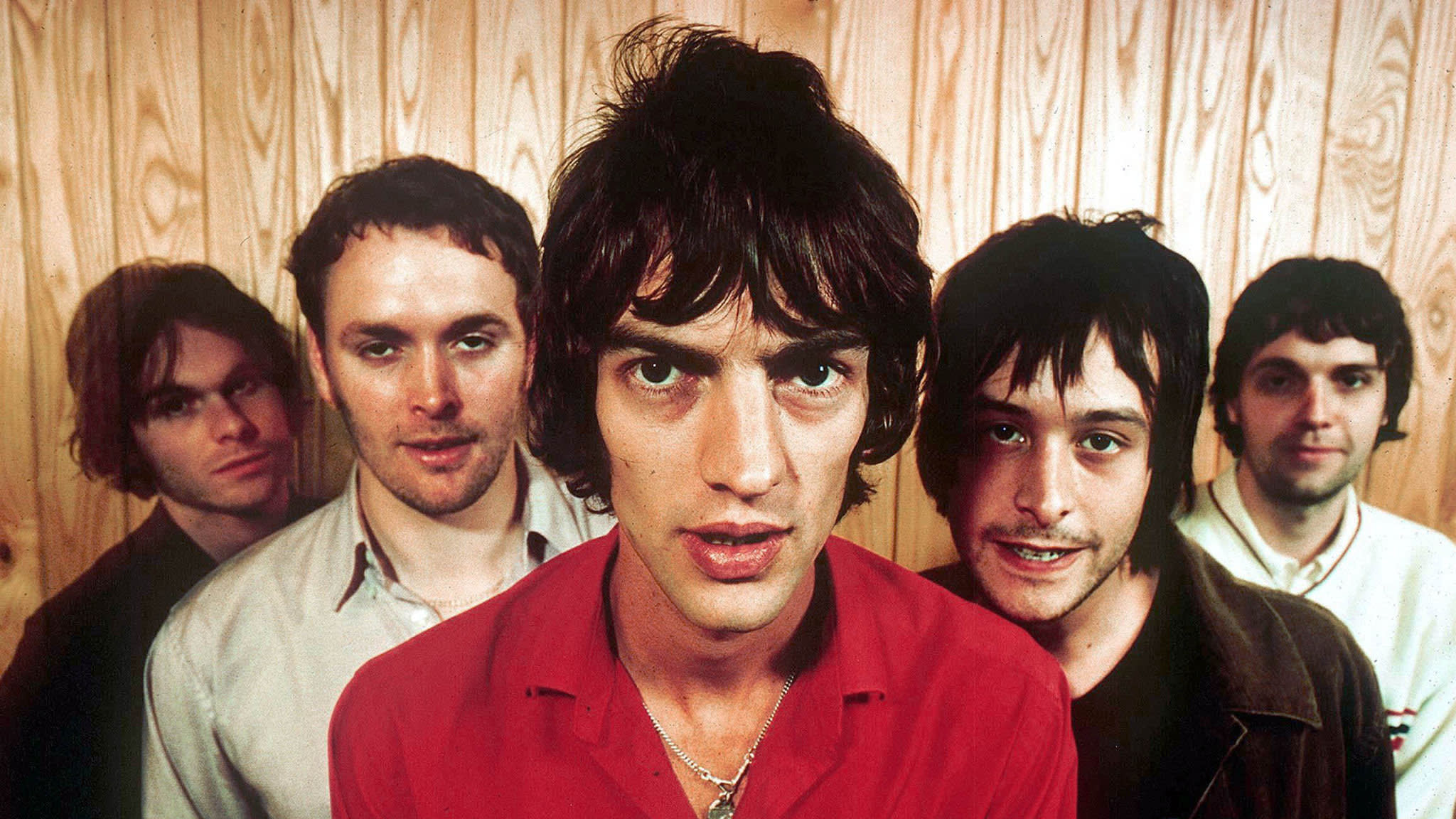
The Verve went through the clichés that destroy world-famous bands before they became world-famous. The Wigan-born group amassed a UK following in the 1990s with their sludgy, psychedelic-tinged sonic affront on songs such as “She’s a Superstar”. A slot at the 1994 Lollapalooza festival was supposed to be their US breakthrough, but, charged on drugs and booze, they destroyed hotel rooms and wound up in jail cells and hospital rooms. Amid exhaustion and infighting, lead singer Richard Ashcroft broke up the band in 1995, just as singles from their more polished second album reached respectable UK chart positions.
Months later, Ashcroft reassembled The Verve to record a new set of songs. One of them became a global smash and also the source of the sourest experience of The Verve’s sour existence.
“Bitter Sweet Symphony” is a six-minute micro-sonata built around an orchestral riff from a forgotten 1965 novelty record, The Rolling Stones Songbook, credited to the Andrew Oldham Orchestra. On the album, Andrew Loog Oldham, The Stones’ former manager and producer, turned a few of their songs (and there were only a few then) into symphonic easy listening. Ashcroft thought Oldham’s version of “The Last Time” could be “turned into something outrageous”.
The Verve looped four bars of the Oldham track. “We did 47 tracks of music beyond that little piece,” Ashcroft later said. “We’ve got our own string players, our own percussion on it. Guitars.” The song is rich, propelled by the kick of the drum track, but the fluttering symphonic riff made it irresistible.
The lyrics were classic Ashcroft: music vs misery. Life was a “bittersweet symphony” of “trying to make ends meet; you’re a slave to the money then you die” — except for brief moments when you turn on your stereo and “let the melody shine”.
Lyrical bleakness was no commercial barrier in the late 1990s. The first single of 1997’s Urban Hymns album, “Bitter Sweet Symphony” became an omnipresent hit across Europe and the English-speaking world and launched The Verve into amphitheatres. It was one of the crowning songs of the Britpop era, ubiquitous at UK soccer matches.
The band had unknowingly crossed Allen Klein, the pit bull of a former manager for The Rolling Stones who owned the publishing rights to their early catalogue. The Verve had an agreement with the record company Decca to use the sample. But Klein’s company ABKCO held the publishing rights to “The Last Time” and he used them as a crowbar to strip The Verve of everything he could.
Lawyers for ABKCO wrangled 100 percent of the royalties and forced Mick Jagger and Keith Richards to be credited as the sole songwriters (leading to a Grammy nomination for the pair for “writing” a song they didn’t). Oldham, who filed a smaller lawsuit, was credited as the performer. For creating a global hit, Ashcroft got $1,000 and credit for the lyrics in the liner notes.
“It’s almost a self-fulfilling thing with the song’s lyrics,” he told Vogue. “You’re not going to just sing about it and be a rock’n’roll star and make loads of money without dealing with the reality that there’s vipers and snakes and vampires all around trying to suck your blood.”
Jagger and Richards, who had their own fraught relationship with Klein, didn’t get involved. There was an underlying irony: The Stones had lifted the structure of “The Last Time” from “This May Be the Last Time”, an American spiritual in the public domain. They had heard The Staple Singers’ version.
Pre-existing tensions broke up The Verve again in 1999. “Bitter Sweet Symphony” has had an afterlife, although, because of the majesty of the original, few have attempted serious covers. Dig deep into YouTube and Spotify and you’ll find some have tinkered with it. Oasis’s Noel Gallagher has performed an acoustic cover. Rap-rock band Limp Bizkit paired it with Mötley Crüe’s “Home Sweet Home” for a mash-up to end their greatest hits album. Beyoncé uses the symphonic part in live performances of “If I Were a Boy”. Kanye West has rapped over the riff when touring with an orchestra.
Ashcroft said last year that he was going to try to recover some of the $50m he estimates he lost to Klein (who died in 2009). ABKCO still holds the right to “Bitter Sweet Symphony”, but in May this year, Jagger and Richards (in agreement with Klein’s son) signed over their credits on the song to Ashcroft. The former Verve frontman called it “life affirming”, creating one pleasant coda for this bitter saga.
What are your memories of ‘Bitter Sweet Symphony’? Let us know in the comments section below.
‘The Life of a Song Volume 2: The fascinating stories behind 50 more of the world’s best-loved songs’, edited by David Cheal and Jan Dalley, is published by Brewer’s.
Music credits: Virgin UK; Decca — Pop; Vanilla OMP; Eleven Seven Music; Universal Music Group International
Picture credit: Roger Sargent/Shutterstock