
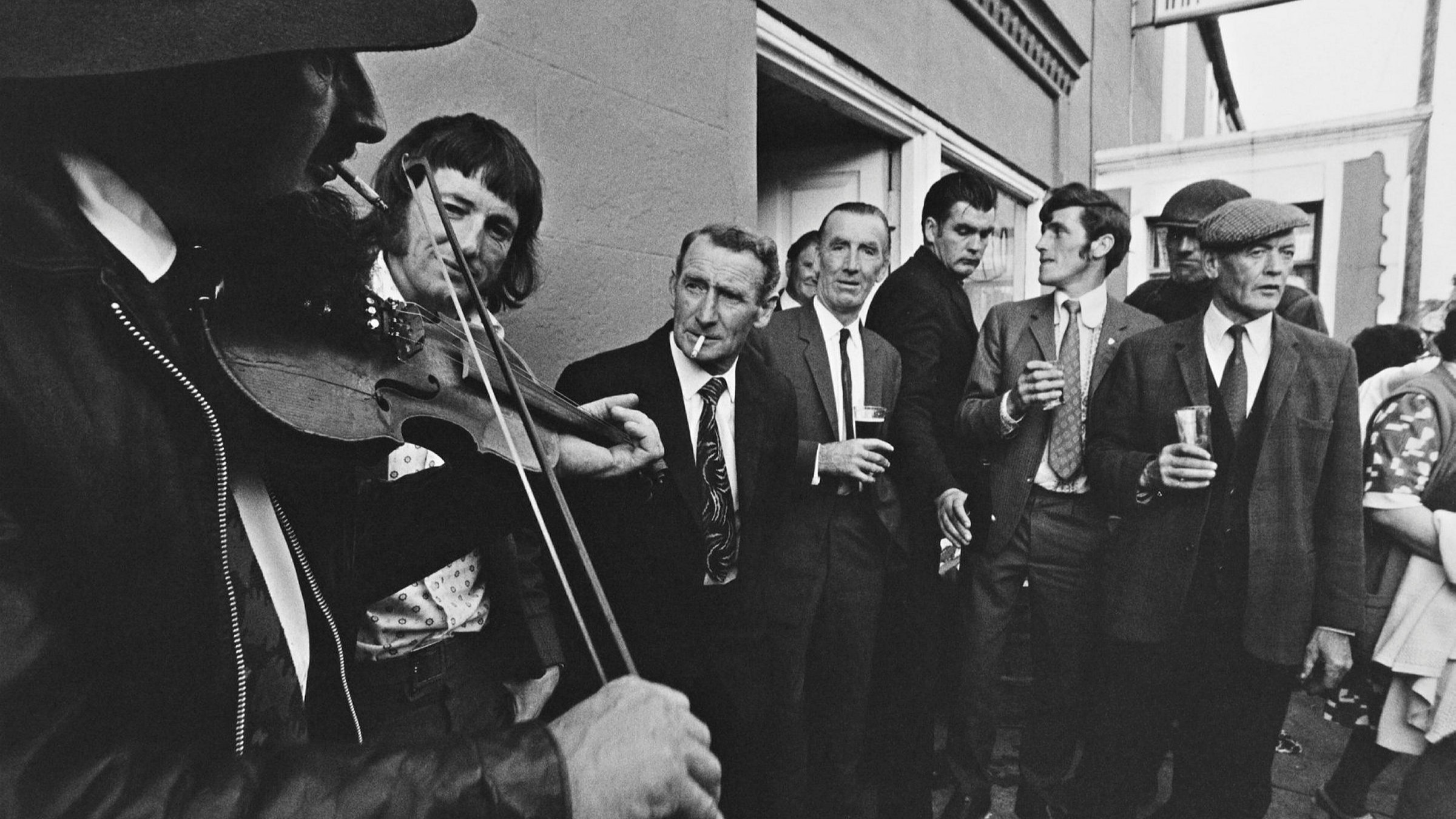
To many, Danny Boy is the embodiment of Oirish Blarney-Stone cliché, but when you hear your cousin play the tune on a violin at your parent’s funeral, the walls of cynicism come tumbling down, along with the tears. The tune’s loveliness triumphs. It is a favourite of pub singers everywhere, a closing-time standard.
No one can claim authorship of the melody. In 1851, Jane Ross, of Limavady, County Londonderry, Ireland, heard a fiddler playing a tune in the street. She took notation and sent it with nothing but the remark “very old” to a friend in Dublin, artist and archaeologist George Petrie, who was collecting Irish folk tunes. He titled the nameless refrain Londonderry Air, in honour of its provenance, and had it published in Ancient Music of Ireland (1855).
Though it’s very much an Irish anthem, the words to Danny Boy were written by 62-year-old Englishman, Frederic Weatherly, of Bath, Somerset, in 1910. Weatherly was a practising barrister who wrote songs in his spare time, including The Holy City — mentioned in James Joyce’s Ulysses — and Roses of Picardy, a big hit during the first world war. But Danny Boy had no tune until 1913, when Weatherly’s Irish sister-in-law Margaret Weatherly sent him Londonderry Air from Colorado, where she’d heard it being played by Irish immigrants. A few minor adjustments to his lyric and it clicked into place with the tune.
Numerous songs had already been written to the melody of Londonderry Air, but none had the impact or staying power of Danny Boy. Hugely and perennially popular among those of Irish descent the world over, the song tells of glens, mountains, the sea, spring, meadows, snow; the stuff of universal lyricism. It carries that most Irish sentiment, a sense of lonesomeness; the emigrant’s yearning for “home” from “yonder”, and is perfectly geared for a solo violin or a penny whistle. A spare backing works better than lush orchestration.
The first public performances were by English singer Elsie Griffin, who performed it widely, including singing it for British troops in France in the first world war. The first recording was made in 1915, by German contralto Ernestine Schumann-Heink, famed for her Wagnerian roles. Hundreds followed.
Colin O’More (1928). Handles it well, if a little heavy-handed with the Hibernianism. The thin backing and crackly shellac add atmosphere.
Steve Gibson and The Red Caps (1947). Light-hearted and humorous, with an inebriated hopalong lilt.
Those magicians of the voice box blessed with superior technique run the song through their personal beautifying filters: a super-smooth Andy Williams, a tremulous and gorgeous Judy Garland, a crystalline Sam Cooke and a plangent Judith Durham. The pipes are calling.
Bing sings it of course, in his trademark croon (1943), but he’s too intimate. There’s no catharsis when you’re almost swallowing the mic.
Jackie Wilson (1952) treats us to a personal display of Londonderry Air-obatics as his glistering vocal machinery swoops and hovers effortlessly up, down and across the range.
Maureen O’Hara (1962). And why not? Hollywood’s very own green-eyed, fiery red-headed colleen combines theatrical nano-pauses with exactly the right amount of dramatic emphasis at the start of words “Oh, DDanny, BBoy...”
Mr “Only the Lonely”, Roy Orbison, rips it apart and puts it back together again (1972), and he pulls it off, on his terms; with his voice, it has no choice.
Elvis sings it respectfully and rather forgettably, in late-Elvis style, 1976, whereas Jerry Lee Lewis gives it a stately blues treatment, punctuated by his semi-automatic glissando flourishes on piano, with an undertow of swirling organ. He really shows us what a fine singer he was in 1965.
The Kelly Family, all of them, fully extended, from tots to grandas. It’s 1979 but they seem to exist beyond earthly time, in green shawls and green kilts and incredible amounts of hair. There’s a fiddle, a tin whistle, an accordion and a mad duet between a bald, beardy old fella and a child, where Danny Boy is kicked and trampled into the turf by a pair of mismatched and very heavy Irish brogues. It’s strange and utterly mesmerising.
Northern Irish singer Rose-Marie (1987) sings with a nice catch in her throat, and is backed by the sound of wind — real wind, not wind instruments — and birdsong. Sounds gimmicky, but it works.
There are a number of choral recordings — The King’s singers (1985), The Swingle Singers (1991), The Harvard Krokodiloes (1995) — all perfect, pure and cold, and too communal. Danny Boy benefits from the sound of a sole heartbroken soul.
Of the millions of instrumentals, few capture the spirit of Danny Boy/Londonderry Air better than that by Eric Clapton (1996), where the subdued strumming of an acoustic guitar in front of a sepulchral heart-beaty rhythm sounds like the playing of someone who really understands the feeling of loss.
For sung performances, it would be hard to match American tenor Robert White on the BBC’s Val Doonican show in the 1970s. Watch the YouTube clip for the bonus of Doonican’s genial introduction. White has the perfect highish tenor voice that is genuinely thrilling when it scales the upper registers with sure-footed grace and agility. No tricksiness, no grandstanding, just straight and true. Frederic Weatherly would surely have approved.
What are your memories of ‘Danny Boy’? Whose version is the best? Let us know in the comments section below.
‘The Life of a Song Volume 2: The fascinating stories behind 50 more of the world’s best-loved songs’, edited by David Cheal and Jan Dalley, is published by Brewer’s.
Music credits: Delos; Jasmine Records; Warner Classics; Virgin; The Harvard Krokodiloes; MGM Records; A.1. Records; Flare Records; BGO Records; EU Import; Gold; Wnts; Hallmark; RCA Victor/Legacy
Picture credit: Jill Freedman/Getty