
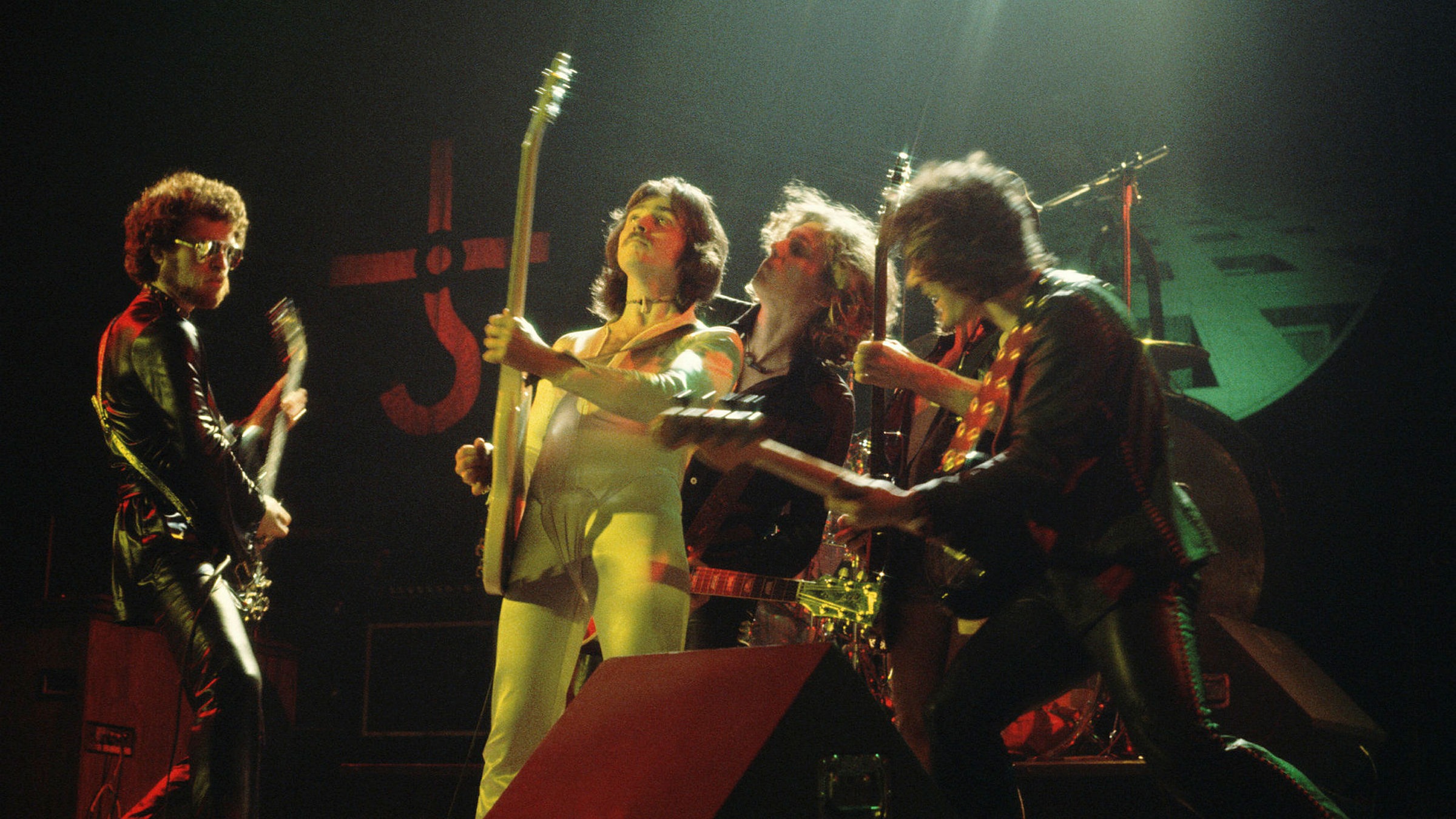
“The cowbell?” laughs Buck Dharma, when asked about his band’s greatest hit. “We’ve made our peace with the cowbell. And it sorta tied the whole groove of ‘The Reaper’ together…”
It was 1976 when co-producer Dave Lucas overdubbed the signature percussion on to Blue Öyster Cult’s “Don’t Fear (The Reaper)”. The New York Record Plant studio in which the song had been recorded had thick shag carpets, which deadened the band’s sound. The cowbell was one component of the engineer’s “magic sauce” used to lift the groove. It was played by band member Albert Bouchard, who covered the bell in gaffer tape and hit it with a timpani mallet. The way radio stations compress sound lifted Lucas’s clanging right to the top of the mix, allowing Saturday Night Live’s comedians to let rip in April 2000.
In one of the most popular SNL sketches of all time, Christopher Walken played fictional producer “THE Bruce Dickinson” manically inciting the band’s percussionist (played by a spatially challenged Will Ferrell) to pile on “More cowbell! More cowbell!” The silliness was a brilliant foil for the song’s dark themes and the guitar community’s reverence for its hypnotic riff.
Dharma, the son of a jazz saxophonist, was born Donald Roeser in 1947. He wrote the song when he was just 22, after being diagnosed with an irregular heart condition. Forced to consider the possibility that he might die young, Dharma soothed himself by writing lines about the inevitability of death. “Seasons don’t fear the reaper,” he wrote, “Nor do the wind, the sun or the rain/ We can be like they are… We’ll be able to fly… Baby I’m your man.”
“I imagined a couple,” he told The Guardian in 2019. “One of them dies but is able to come back for her lover, and they go to this other place no one knows about. I sang about Romeo and Juliet as an example of a couple who have successfully gone to the other dimension, but I got a lot of grief over it because everyone thought I was promoting suicide. ‘Romeo and Juliet are together in eternity,’ I sang, but I wasn’t suggesting that people kill themselves to find out what it’s like.”
The lyrics also contain a factual error. Dharma guessed that around 40,000 people around the world died every day at that time. In fact, the figure was much higher — today it’s around 150,000.
“The Reaper”’s sound was quite pretty for the “scrabbling, semi-underground” band who started life as Soft White Underbelly in 1967. In their early days they played psychedelia and supported The Byrds, whose jangly influence can be heard in “The Reaper”’s sweet vocal harmonies and cross-picked riff. But by the mid-1970s BÖC had embraced a harder rock. They were opening for Alice Cooper.
The band’s other lead singer, Eric Bloom, worried that Dharma’s “soft” tune might alienate their new fan base. But it was the hit that took BÖC into the mainstream. It’s been covered by bands as diverse as Goo Goo Dolls (snarly punk, 1987), Big Country (earnest, 1993), The Beautiful South (witty salsa, 2004) and Heaven 17 (cheesy rave, 2005).
Some fans might also note a similarity between the song’s melody and that of The Police’s 1979 hit, “Message in a Bottle”. Interviewed by guitarplayer.com this year, Dharma said Sting had privately admitted that “he ripped off ‘Reaper’. He kept the rhythm, but he changed the melody around, so it wasn’t a real steal. I said, ‘Well, you’re welcome to it because you did a nice variation on it.’”
“The Reaper”’s eerie atmosphere and existential musings appealed to writers, film-makers, artists and stoners. Novelist Stephen King said it inspired his 1978 fantasy novel The Stand, in which a lethal strain of influenza is developed as a biological weapon. The song was played in both the 1994 and 2020 mini-series of the book.
The song made its first film appearance in John Carpenter’s 1978 horror classic, Halloween. Carpenter made the song so synonymous with horror that it would later appear in Scream (1996) as a cover by Gus Black, in The Frighteners (1996) (a version by The Mutton Birds) and in Rob Zombie’s 2007 Halloween remake. It added menace to a car ride in David Fincher’s 2014 thriller Gone Girl.
But it’s that SNL sketch that most people remember. Christopher Walken says he still gets cowbells delivered backstage when he performs on Broadway. BÖC’s Eric Bloom has been amused to see the call for “more cowbell” enter the language as shorthand for “more fun”. Bouchard remembers the instrument as signifying “the relentless march of the clock”.
Today Dharma says the band always play the song “as a memorial to people that have passed. It’s something you play or say when someone passes away. And I’m good with that. I’m gonna play it at my funeral.”
What are your memories of ‘Don’t Fear (The Reaper)’? Let us know in the comments section below.
‘The Life of a Song Volume 2: The fascinating stories behind 50 more of the world’s best-loved songs’, edited by David Cheal and Jan Dalley, is published by Brewer’s.
Music credits: Sony Music cmg; Mercenary; Cherry Red Records; PID; Phantom Sound & Vision; UMC-Polydor; Active; Virgin
Picture credit: Sony Music Archive via Getty Images