
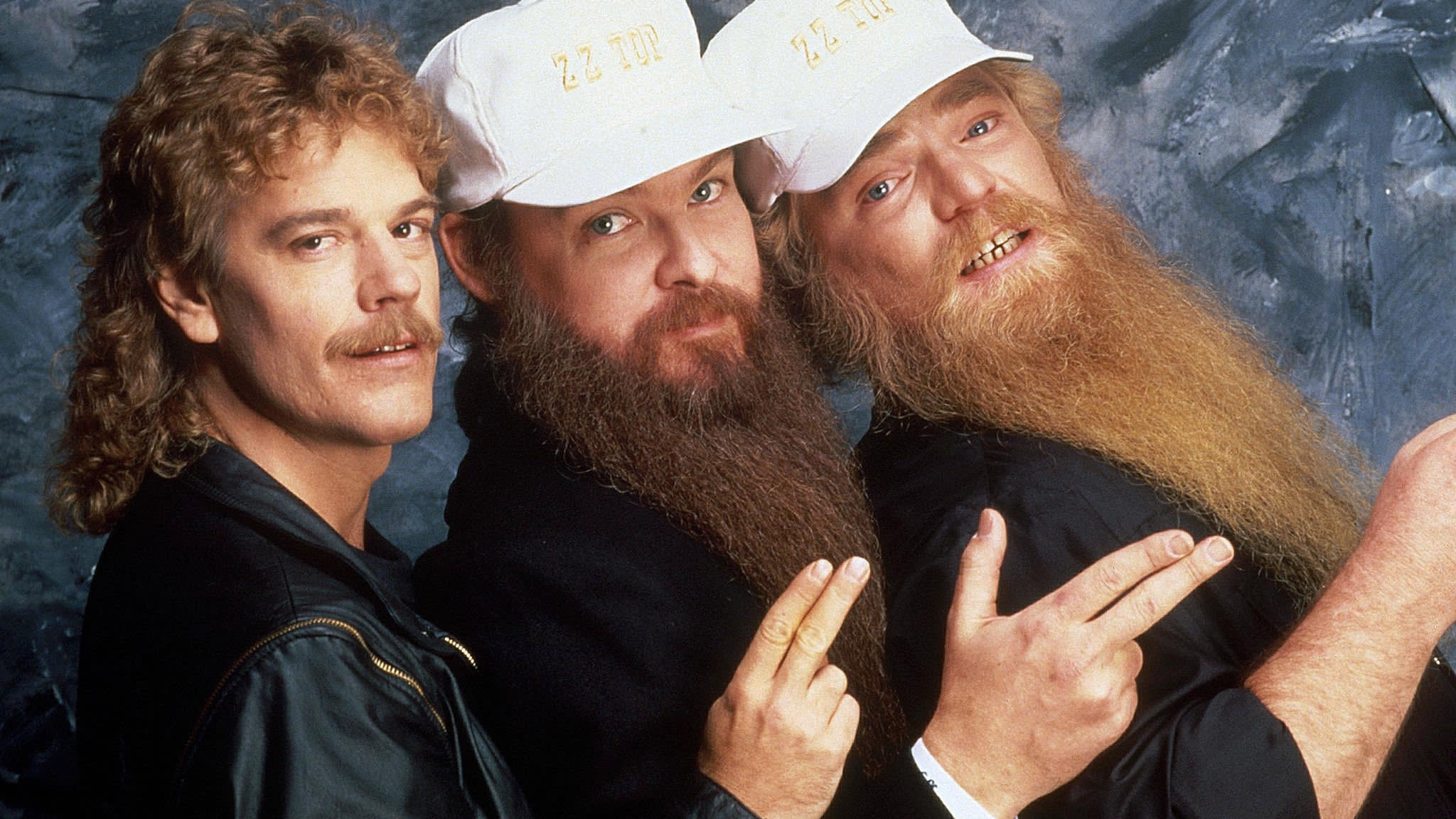
Most people thought ZZ Top were just a blues band until 1982, when Billy F Gibbons — the Texan band's guitarist, principal singer, principal songwriter and de facto leader — had a moment of revelation. “The crack in the code was the fact that the drum machine introduced for the first time to the listening ear close-to-perfect time, which had been the aspiration of musicians since the invention of the metronome,” he told me in 2012.
Gibbons was no hidebound traditionalist. A visit to London in 1977 – on one of Freddie Laker’s cheap Skytrain flights – had opened his ears to the “energy event” that was punk, and oddness became increasingly prevalent on ZZ Top’s records over the next few years. Then the flowering of electronic music in the UK captivated him — Depeche Mode and Orchestral Manoeuvres in the Dark, especially — and he saw the possibilities for his own music if he were to deploy this technology. The result was the album Eliminator, recorded in 1982 and released the following year, the first ZZ Top record to be a worldwide smash, and widely believed — though never officially confirmed — to be a Gibbons solo record in all but name.
Eliminator’s lead single, the song that signalled change was afoot, was “Gimme All Your Lovin’”, one of those rock songs in which every element seems to have been perfectly calibrated, without sounding calculated (though it undoubtedly was). It opens with a drum pattern so regimented it’s hard not to fall in line, before Gibbons’ guitar riff — itself often punctuated with little stutters of noise — comes in. The verses are perfunctory, little more than a mechanism to get us to the chorus as quickly as possible, a chorus so natural that the song cannot be disrupted with middle eights or bridges or pre-choruses. It’s all about the interlocking elements — controlled by Midi computer systems — locking into their mechanical groove to bring us back to that chorus. In its own way, “Gimme All Your Lovin’” is as perfect a piece of electronic music as anything by Kraftwerk, programmed to the 120bpm that is, apparently, the most comforting tempo for human listening.
“Gimme All Your Lovin’” fed into several divergent strands of pop culture: the newly prevalent pop video (the result of Frank Beard, the drummer who barely appears on Eliminator, becoming obsessed with MTV), hair metal, slick AOR and electronic music. The LA hardcore punk band Black Flag became obsessed with Eliminator — “That was our soundtrack for 1984. I think we wore out that cassette three times,” singer Henry Rollins later remembered — and Black Flag’s obsession later inspired the art rock band Xiu Xiu’s dissonant, despairing version: Xiu Xiu regularly listened to Henry Rollins' tour diaries, released on cassette as Get in the Van, in which the song often came up. Leningrad Cowboys, in company with the Red Army Choir, turned it into a polka, incorporating both the Russian national anthem and the Hallelujah Chorus, obviously. By contrast, the blues guitarist Walter Trout offered a pointlessly faithful rendition.
But the song’s synthetic throb made it best suited for those with an interest in electronics, and so the American industrial band Filter tried to de-emphasise the song’s inherent niceness. The most successful version, commercially at least, came from the house divas Jocelyn Brown and Kym Mazelle, who had a UK hit single in 1994 with their Hi-NRG rendition, speeded up to 129bpm and produced by Mike Stock and Matt Aitken (of Stock Aitken Waterman fame), two producers who knew the commercial power of combining the pulse of the gay disco with a huge chorus.
“Gimme All Your Lovin’” began an unlikely imperial period for ZZ Top, in which they were constants on MTV, and three Texas bluesmen became bona fide pop stars. But Billy Gibbons retained his weirdness. On the release of Eliminator, he was asked by one journalist why it was the group’s first album in a decade not to have a Spanish title. Carefully, Gibbons put him right, by enunciating the record’s actual name: El Iminator.
Do you have any personal memories of ‘Gimme All Your Lovin’’? Let us know in the comments below.
‘The Life of a Song Volume 2: The stories behind 50 more of the world’s best-loved songs’, edited by David Cheal and Jan Dalley, is published by Brewer’s
Music credits: Rhino/Warner Bros; Johanna Kustannus Oy; Vinyl Masters; Modal Production Group Ltd
Picture credit: Sipa Press/REX/Shutterstock