
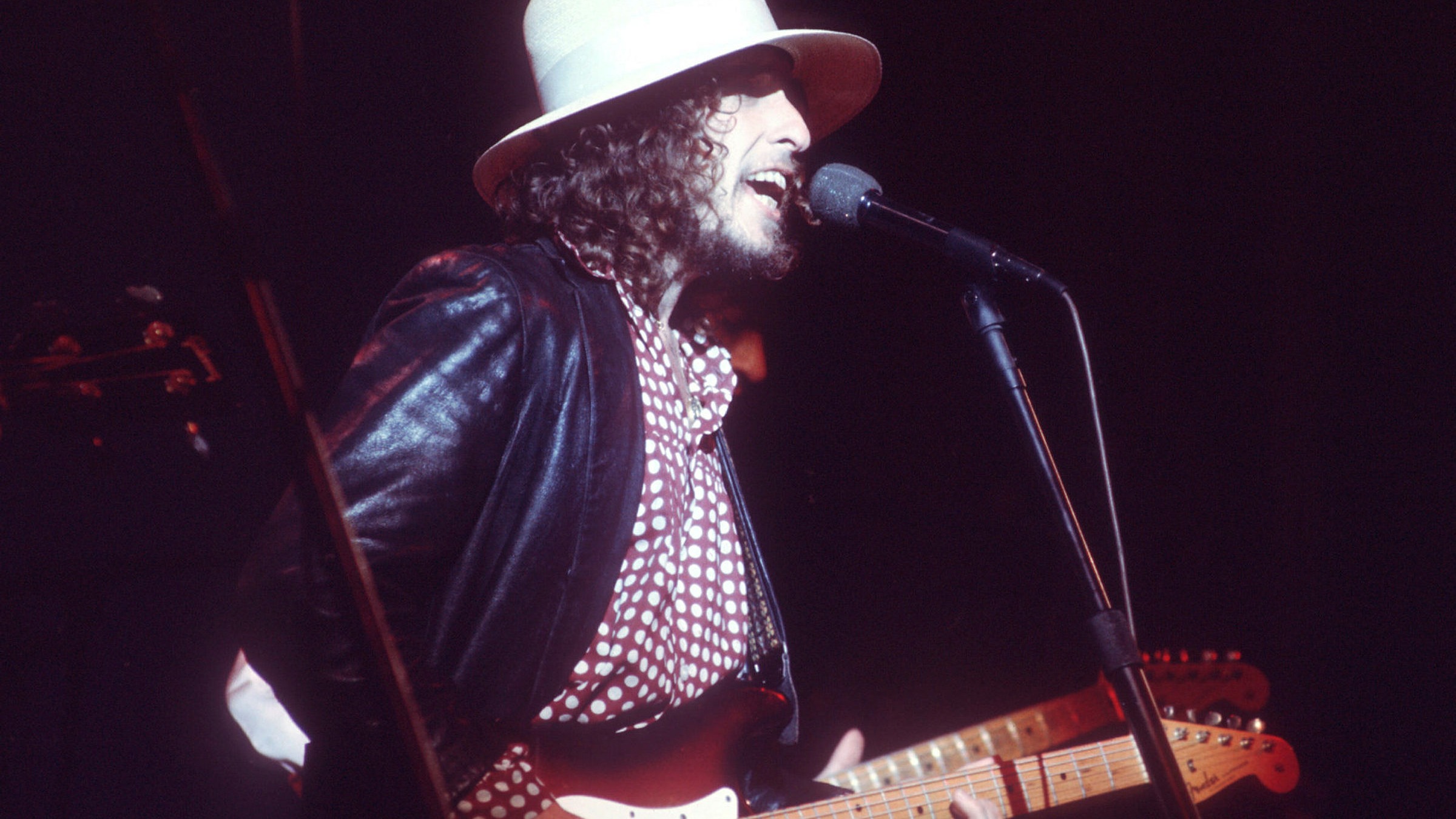
“Pistol shots ring out in the bar-room night… ” — the opening line of Bob Dylan’s protest ballad “Hurricane” sounds more like the start of a classic noir thriller by Raymond Chandler. The song is one of Dylan’s most detailed narratives, telling the story of Rubin “Hurricane” Carter, a black middleweight boxer who was framed by the police for a triple murder that took place in a Paterson, New Jersey, bar in 1966.
Dylan discovered the case in 1975 when Carter published his life story, The Sixteenth Round. Intensely moved, the singer travelled to Rahway State Prison to visit the man who, in the words of the song, “at one time, could’a been the champion of the world” but was now “an innocent man, in a living hell”.
The resulting song was written fast, with collaborator Jacques Levy forming the powerful rhyming lyrics, which are unusual among Dylan’s ballads for their clarity and structure. In a later interview, Levy said of his role: “I think [Dylan] liked the idea that I could tell a story. Bob is not that good at telling stories. He’s got a lot of good stuff in his songs, but they don’t usually add up to a story.”
“Hurricane” definitely adds up to a story, specific, detailed, hard-hitting. It was recorded in the summer of 1975 with musicians from the Rolling Thunder Revue— notably Vinnie Bell on 12-string guitar, powerful drums and percussion from Howie Wyeth and Luther Rix, and most memorably the brilliant gypsy-style violin of Scarlet Rivera, whose long, swooping musical lines lend a wild, exhilarating quality to counterpoint the harsh thump of the lyrics.
But there were problems: lawyers at Columbia Records fretted about possible lawsuits, especially from Arthur Dexter Bradley and Alfred Bello, the two white witnesses who — as the song vividly describes — were cajoled and threatened by police into identifying Carter and his co-defendant John Artis.
A rewritten version had to be recorded, this time with Ronee Blakley providing the vocal harmony. Even after its release — as a single in November 1975, and on the Desire album the following year — there was more legal trouble when Patty Valentine, another eyewitness named in the song, brought an unsuccessful lawsuit; accusations of factual errors in the storytelling also dogged the ballad.
Despite all that, it grabbed the public imagination, combining as it does the passionate rage against injustice of Dylan’s protest songs — of feeling “ashamed to live in a land/Where justice is a game” — with fuel for the race-relations ferment of the time in its tale of two black men cynically framed and convicted by white cops, white witnesses and an all-white jury.
In December 1975, Dylan played a concert at New York’s Madison Square Garden which raised $100,000 for Carter’s defence and, whether or not it had anything to do with the song, in 1976 Carter and Artis were granted a new trial. This was unsuccessful, and it wasn’t until 1985 that Carter was finally released from jail, a new judge ruling that the original prosecution had been “based on racism rather than reason”. By this time, Rubin “Hurricane” Carter had spent 19 years in jail.
“Hurricane” sits firmly within the folk tradition of “outlaw” songs — Woody Guthrie was always a model for Dylan — as well as the newer line of ballads about injustice, which includes his own “The Lonesome Death of Hattie Carroll”. Also on the Desire album was Dylan’s “Joey”, the story of another outlaw, vicious Brooklyn mobster Joey Gallo.
That song brought Dylan considerable flak, for portraying a ruthless crime boss as an innocent victim of the system. Yet it was “Joey”, not “Hurricane”, that had a long life in Dylan’s touring repertoire. Fans have long puzzled over the fact that Dylan almost never performed “Hurricane” live — had he lost interest once Carter was freed? The answer could be simpler: it’s a hugely challenging song. At eight and a half minutes (on the single, it took up the A and B sides, and the album version was spliced together from two takes), with words that have to be distinctly enunciated and a story that needs to be told in full, it’s a real feat of memory, and very ill-suited to Dylan’s later rambling, improvisatory performance style.
This may also account for the very few covers of the song. Among them, in 2000 Ani DiFranco created a quasi-rappy, semi-spoken version against a thumping, syncopated beat; in 2011 Middle Class Rut produced a shouty, driving-rock version that lasts a seemingly interminable eight minutes; New Rising Sun (at a full nine minutes) made perhaps the best stab at it, helped by a violinist who captures something of Rivera’s thrilling original.
With so little afterlife, “Hurricane” remains perfectly of its time — yet with remarkable resonance today. More than 40 years on, so little has changed.
What are your memories of ‘Hurricane’? Have you seen Dylan sing it live? Let us know in the comments section below.
‘The Life of a Song Volume 2: The fascinating stories behind 50 more of the world’s best-loved songs’, edited by David Cheal and Jan Dalley, is published by Brewer’s.
Music credits: Columbia/Sony; Righteous Babe; Bright Antenna
Picture credit: Michael Ochs Archives/Getty Images