
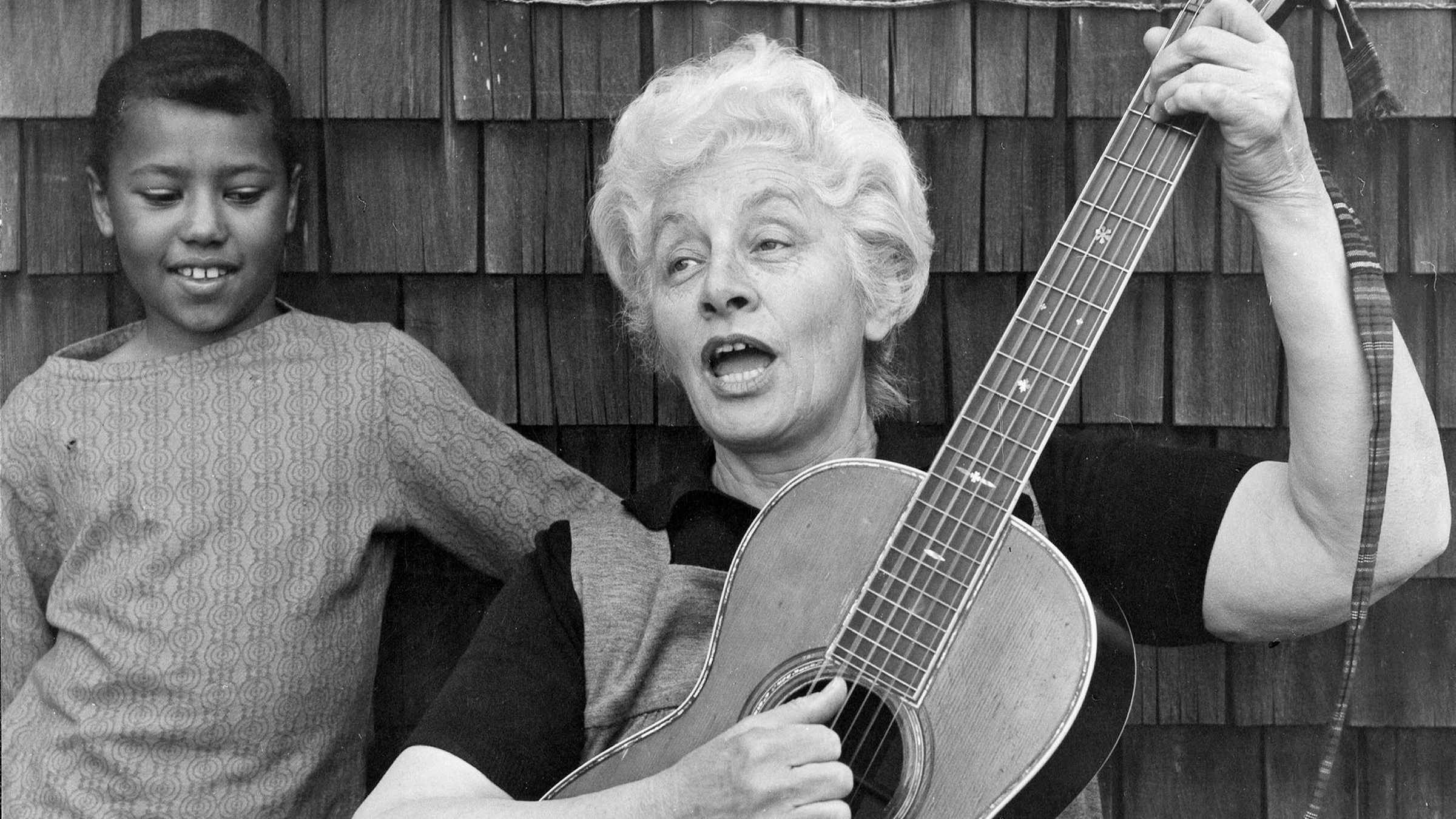
Don’t be fooled by the upbeat tempo: “Little Boxes”, with its houses “made of ticky-tacky”, is a mournful ditty of suburban malaise — a landmark in folk singer and political activist Malvina Reynolds’s songbook. Disarmingly buoyant, with a nursery-rhyme melody, the 1962 song sharply critiqued the growing conformity and consumerism of the US.
Some of the best songs happen on the fly, and Reynolds, who was 62 when she wrote “Little Boxes”, had the idea when she was driving through Daly City, Northern California. She was horrified by the rows of new tract homes, “little boxes on the hillside/little boxes all the same”. In her scribbled lyric, the song’s seed was sown.
Reynolds also felt Americans were being chivvied into what she called “cookie-cutter” lives; to go to university — “where they all come out just the same” — and to graduate into white-collar jobs, while green space succumbed to identikit neighbourhoods for the burgeoning middle classes: the “doctors and lawyers/And business executives”. The continual use of “and” in “Little Boxes” renders this fate breathless — one thing inevitably leads to another. The song is succinct, at just two minutes and 11 seconds. It’s a boxed firework: constrained, but ready to explode.
In the 1960s, academics chewed over “environmental determinism” — the idea that surroundings determine one’s outcome. Tract homes were, to the nascent counterculture, ambition-snuffers. Making these houses even more miserly, beyond their bland aesthetic, is their geography: designed for automobiles, they isolate. Creativity dies in suburbia.
Reynolds did not release her own version of “Little Boxes” until 1967, but it blew up when her friend, the folk singer Pete Seeger, covered it in 1963: the song resonated powerfully with the burgeoning folk-and-protest movement.
Born in San Francisco at the century’s turn to Jewish immigrants from Russia and Hungary, Reynolds was a life-long socialist. She was blacklisted for her activism, initially barred from university. By association, Seeger was blacklisted too.
A musical child, Reynolds played violin and would “fool around” on the piano. After earning a doctorate in English from Berkeley, she took on odd jobs — as a milliner, a social worker, and at a steel foundry — before finding her place in folk. “My head was full of poetry and music, and they came together into songs,” she explained in the 1977 documentary Love It Like a Fool. “Everything I thought began to turn into song. And because my thinking was social and political, quite a few of my songs had this character.”
There would be many more covers of “Little Boxes” over the years, each with a unique spin. In 2006 Elvis Costello lent it his trademark smokiness; Devendra Banhart gave the melody a sensuousness for the 2007 Song of America compilation album, which comprised 50 songs thought to best represent the history of the US. It’s been translated into other languages, most notably for Adolfo Celdrán’s 1969 Spanish version, “Cajitas” (“cajitas en la colina/ cajitas de tiki-tak”), and Graeme Allwright’s “Petites Boîtes” (which are “très étroites”). From 2005 it was used as the theme for the Showtime TV series Weeds, a black comedy about a suburban widow who starts selling marijuana to keep afloat; episodes featured covers by artists including Linkin Park, Randy Newman, Regina Spektor, Ben Folds and Engelbert Humperdinck.
Depending on speed and delivery, “Little Boxes” can be either creepy or jaunty. “Ticky-tacky”, Reynolds’s neologism, became a byword for cheap. The expression elicited knowing laughter from audiences. Not everyone admired the song, however: satirist Tom Lehrer is said to have described it as “the most sanctimonious song ever written”.
Reynolds, who died in 1978, was influential to her peers but remains obscure. As the New York Times wrote in 1972, she was “a composer of topical and non‐topical songs which everybody knows and nobody quite remembers to credit”. Perhaps that was her plan: fame can be its own box, after all.
Sixty years on, “Little Boxes” continues to circulate, being used in countless TV adverts — most recently by telecoms company O2 (“money, shopping, your community — things are changing”, the voiceover purrs). The irony is strong.
What are your memories of ‘Little Boxes’? Let us know in the comments section below.
‘The Life of a Song Volume 2: The fascinating stories behind 50 more of the world’s best-loved songs’, edited by David Cheal and Jan Dalley, is published by Brewer’s.
Music credits: Smithsonian Folkways Recordings; Lionsgate; Thirty One Tigers; Dro East West; EPM