
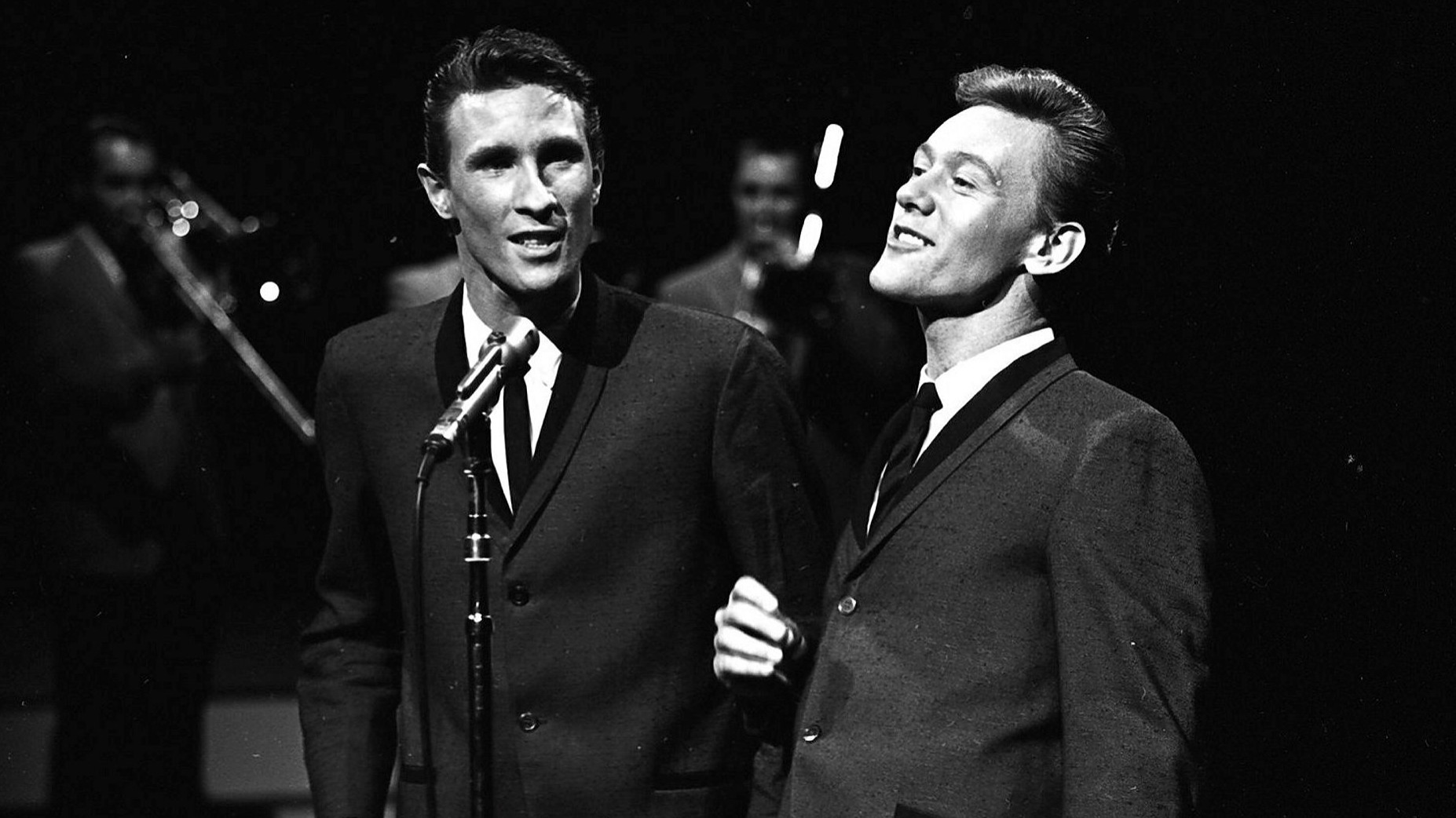
Tom Cruise is famous for doing many of his own stunts, but none are more likely to induce anxiety in the viewer than when, as Pete “Maverick” Mitchell in the 1986 action movie Top Gun, he tunelessly serenades Kelly McGillis’s Charlie with “You’ve Lost That Lovin’ Feelin’”. Top Gun made Cruise a megastar but it certainly wasn’t for his singing. The song features again during the deliciously cheesy end of the film, but this time, thankfully, it’s the original Righteous Brothers version which Charlie plays on a bar jukebox.
The huge success of the movie contributed to the fact that “You’ve Lost That Lovin’ Feelin’” is the most played song of the 20th century on radio and television, according to American performing rights organisation BMI.
And yet Righteous Brother Bill Medley — one half of the duo with the late Bobby Hatfield — has said of the break-up ballad: “We had no idea if it would be a hit. It was too slow, too long, and right in the middle of The Beatles and the British invasion.”
Phil Spector, the boss of the Righteous Brothers’ label, commissioned the song in 1964 from one of the great writing duos, Barry Mann and Cynthia Weil, who numbered “Saturday Night at the Movies” and “We Gotta Get Out of This Place” among their many hits.
Spector, who died of Covid in January, was once celebrated for his pioneering production techniques but is now remembered as a convicted murderer, a man who shot dead actress Lana Clarkson at his home in 2003.
“You’ve Lost That Lovin’ Feelin’” is regarded as the one of the finest examples of his “wall of sound”, a dense, symphonic structure created by recording large ensembles of musicians playing together and using studio wizardry.
In his book 2Stoned, Rolling Stones manager Andrew Loog Oldham describes the first time he heard the song, in Spector’s office: “I had no idea what it was but it was the most incredible thing I’d ever heard… The last chorus was as if Jesus had risen. As if Moses had come down with the Ten Commandments of sound.”
It was three minutes 45 seconds long but, so as not to deter DJs from playing it, Spector lied, saying it was three minutes five seconds.
The song is about the end of a relationship. “You never close your eyes any more when I kiss your lips,” croons baritone Medley at the opening. The moderate tempo and relatively low pitch of his voice apparently led some listeners to think the record was being played at the wrong speed.
The lover being addressed has gone cold on the singer, losing that loving feeling. Tenor Hatfield joins in at the chorus and by the end of the song the singers seem hopeful that passion might be rekindled, that they might be able to “bring back that lovin’ feelin’.”
Author and popular music academic Dai Griffiths says: “The record hinges on the extended bridge section — ‘Baby, baby, I’d get down on my knees for you’ — which occupies nearly a third of the track. Take the bridge away and it’s a deeply expressive song; put the bridge back in and it’s a timeless, classic record. The bridge is built upon a simple harmonic loop — ‘Summer Nights’ from Grease, anyone? — the loop repeated 13 times in all.”
It was released in the US in November 1964, two months before it came out in the UK, and British singer Cilla Black quickly recorded and released her own version, produced by George Martin. Black’s cover entered the top 30 at 28 in January 1965. The Righteous Brothers went in at 35. Black kept ahead for a couple of weeks but peaked at number two, kept off the top by the duo who had flown into Britain to shore up their assault on the charts. Oldham, who looked after The Righteous Brothers in the UK, was irked by Black’s upstart version, and took out an ad in the music press, describing his boys’ record as “the Last word in Tomorrow’s sound Today”.
Black was only the first of a myriad artists to record the song. Elvis Presley, Dionne Warwick, Tom Jones, Etta James and Hall and Oates are among the others. There have been more than 200 covers.
Synth-pop pioneers The Human League included their slightly menacing take on their 1979 debut album Reproduction. Jimmy Page and Paul Rodgers’ “supergroup” The Firm had a version on their eponymous 1985 album, with Tony Franklin’s fretless bass high in the mix. It’s on Westlife’s 2006 covers record The Love Album.
Its appeal has been universal. Almost. Kelly McGillis recalled in an interview: “If I never heard that song again, I would be happy... because every time I went anyplace, people would sing to me.”
What are your memories of ‘You’ve Lost That Lovin’ Feelin’’? Let us know in the comments below.
‘The Life of a Song Volume 2: The stories behind 50 more of the world’s best-loved songs’, edited by David Cheal and Jan Dalley, is published by Brewer’s
Music credits: Spectrum; G Records; Rhino Atlantic; S Records
Picture credit: Walt Disney Television via Getty