
In response to media speculation about the state of his mental health in January 2018, Donald Trump tweeted that “throughout my life my two greatest assets have been mental stability and being, like, really smart… I think that would qualify as not smart, but genius… and a very stable genius at that!”
Randy Rainbow was one of many comedians to make hay with the 45th president’s hubris, crafting new lyrics to a song from 1879. The satirist racked up 3.6m views on YouTube singing:
“He is the very model of a very stable genius/ Of all the US presidents he is the Mussoliniest/ He learned a lot of things according to his Wikipedia/ And demonstrates his ample intellect on social media.”
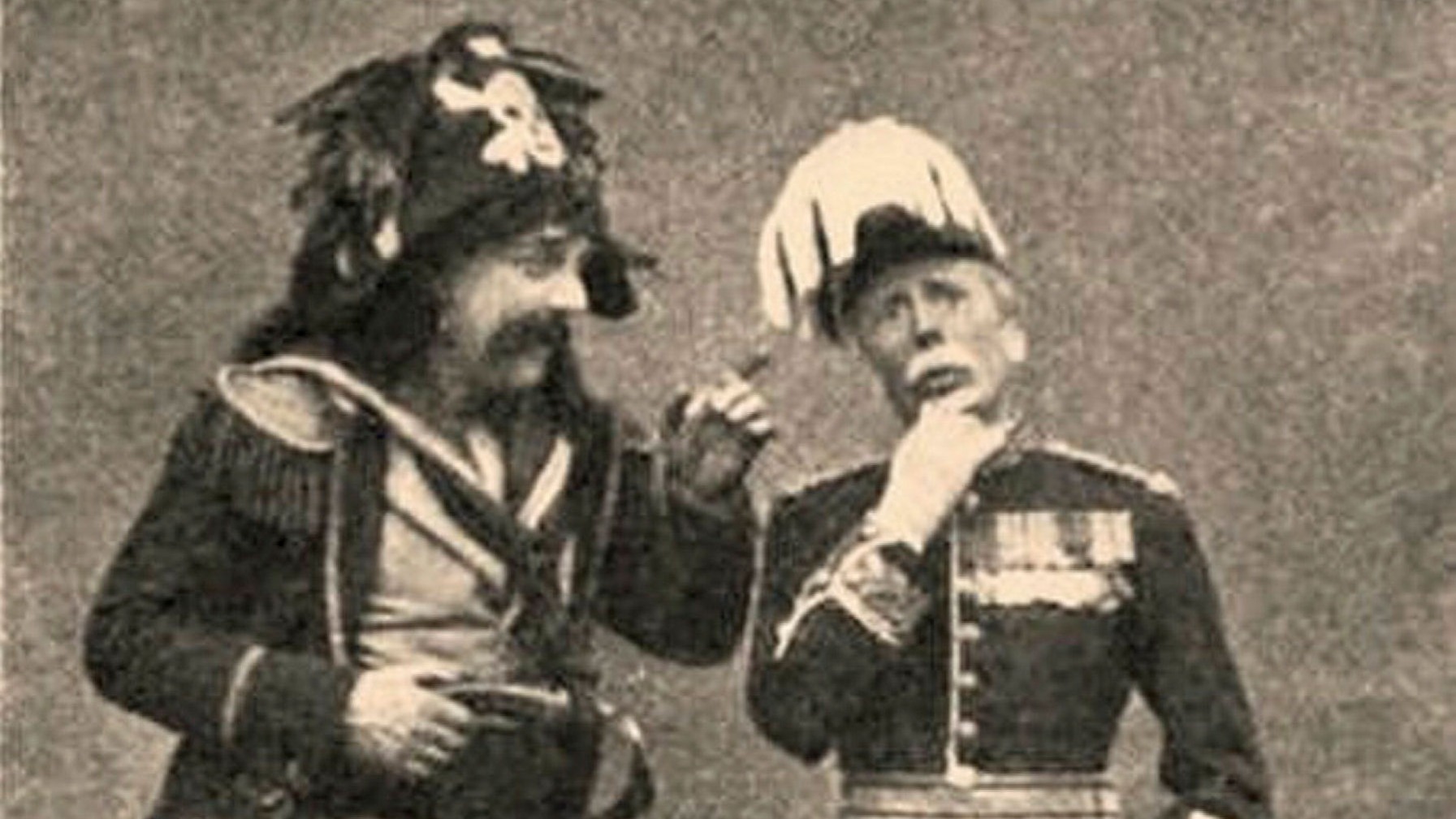
Rainbow was using the tune of “The Major-General’s Song” from the comic opera The Pirates of Penzance by Gilbert and Sullivan (whose HMS Pinafore is currently running at English National Opera). As in his parody, the role of the original song was to expose a man’s laughable unsuitability for a position of power. It’s used to introduce the character of Major General Stanley towards the end of Act One.
Stanley boasts of an impressive but impractical education that means he is able to: “Write a washing bill in Babylonic cuneiform/ And tell you ev'ry detail of Caractacus’s uniform.” But he knows no more of tactics “than a novice in a nunnery”.
With its tongue-twisting polysyllabic lyrics delivered at high speed, “The Major-General’s Song” is a “patter song”. It’s a rapid-fire style that gets its English name from the hasty recitation of the Pater Noster, the Catholic version of the Lord’s Prayer, rattled out by priests in often poorly understood Latin.
In the original London performance in 1880, the role was performed by George Grossmith, now best remembered as co-author (with his brother Weedon) of the 1892 classic comic novel, The Diary of a Nobody. Although it’s now believed librettist WS Gilbert was lampooning his wife’s uncle, at the time Stanley was widely thought to be a caricature of Field Marshal Garnet Joseph Wolseley. Far from being offended, Wolseley would often sing the song at parties to amuse his friends.
Around 80 years later, in 1959, Harvard mathematics lecturer and satirical songwriter Tom Lehrer turned the song into his own party piece, “The Elements”, setting a list of all the chemical elements to the manic meter of Sullivan’s melody. Sucking down noisy lungfuls of air between exhausting verses, Lehrer sang: “There’s antimony, arsenic, aluminum, selenium/ And hydrogen and oxygen and nitrogen and rhenium…” before ending with a rhyme that takes a playful swipe at the Bostonian accent by rhyming “Harvard” with “dis-carrvered”.
The smart-alecky language and precision-engineered rhyme scheme of Gilbert’s original lyrics made their way, via Lehrer, into 20th-century science-fiction nerd culture, which found the song a perfect fit for TV shows. On a 1978 episode of the BBC’s Dr Who written by Douglas Adams (The Pirate Planet), Tom Baker’s incarnation of the Time Lord sang: “I am the very model of a Gallifreyan buccaneer.” The song was also sung in space in episodes of Star Trek: The Next Generation (1992), Babylon 5 (1997) and Star Trek: Discovery (2019). In a 2003 episode of Frasier, Kelsey Grammer’s pompous radio therapist is seen singing the song with his brother, Niles (David Hyde Pierce) while their dad rolls his eyes at their verbosity, pretending to have misheard Gilbert’s line about “the square of the hypotenuse” as “the scary hippopotamus”.
The song had its first YouTube success in 2010 when actor Ron Butler reworked the lyrics to express Barack Obama’s struggles in office. “In spite of special interests I have pushed through major health reforms,” sings Butler’s Obama, “The country was in uproar who’d have thought it’d cause a major storm?/ By fighting to give basic healthcare to each citizen for free/ I inadvertently gave rise and reason to the Tea Party.”
In Lin-Manuel Miranda's hip-hop musical Hamilton (2015), the character of George Washington references the song when he sings: “Now I’m the model of a modern major general/ The venerated Virginian veteran whose men are all/ Lining up to put me up on a pedestal.”
In 2017, the adorably chaotic minions from Universal’s animated film Despicable Me 3 turned the song into giddy gibberish as “Papa Mama Loca Pipa”. As their helium-high voices tear into lines like “toka bocca pissa la lasagnaaa”, you can imagine Gilbert laughing from beyond the grave. The Victorian librettist who loved exposing the absurdity of social hierarchy has often been called an anarchist and a proto-surrealist. He would surely have cherished the tiny yellow henchmen. Selfish, easily distracted and generally inept, they make no claims to be either mentally stable or intellectually capable. They just bounce from one event to the next with a daft cry of “Banana!”
What are your memories of ‘The Major-General’s Song’? Let us know in the comments section below.
‘The Life of a Song Volume 2: The fascinating stories behind 50 more of the world’s best-loved songs’, edited by David Cheal and Jan Dalley, is published by Brewer’s.
Music credits: Decca; Marathon Media International; Atlantic; I Am Other/Columbia
Note: this article has been amended to correct the original reference to Donald Trump, who was 45th president of the United States, not 42nd