
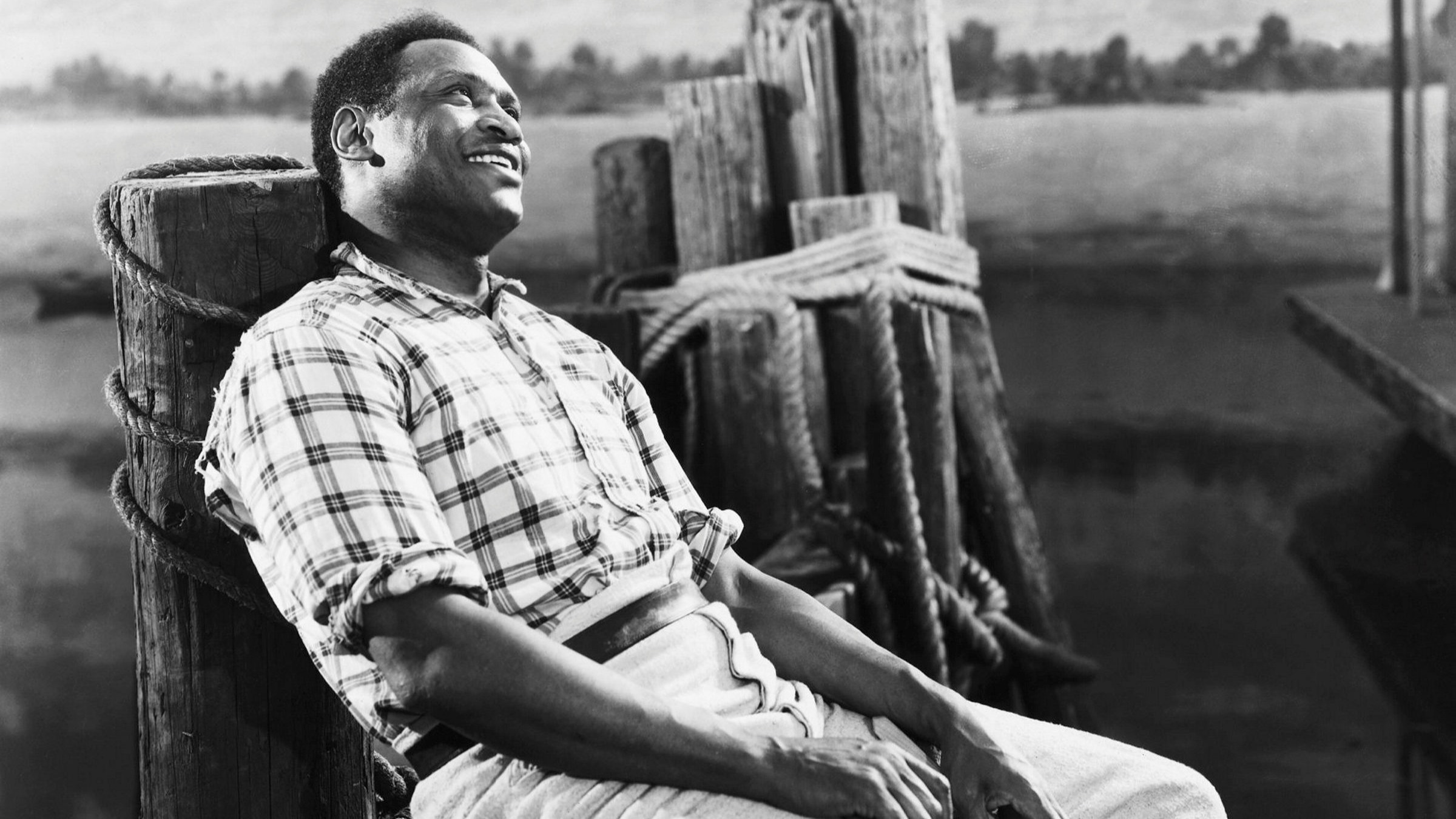
Composer Jerome Kern met lyricist Oscar Hammerstein II in 1925, and after a successful Broadway collaboration on Sunny they set about translating Edna Ferber’s sprawling 1926 novel Show Boat for the stage. The story of life on a Mississippi pleasure boat during the Jim Crow era, involving alcoholism, gambling, so-called miscegenation and racism, looked like grim fare for a Broadway musical. They pitched it to producer Florenz Ziegfeld Jr, of the famous Follies, who was impressed enough to climb aboard. The show was a success, and has never wavered in popularity. As well as “Can’t Help Lovin’ Dat Man” and “Make Believe”, it contained the imperishable “Ol’ Man River”.
It is sung by Joe, a weary stevedore who admonishes the oblivious, implacable river, yet envies its freedom, a freedom he’s unlikely to know, trapped as he is beneath the upstairs glitter of the floating Cotton Palace. He rails against his world of relentless drudgery, where black workers toil “while the white folks play”. The song itself reflects this duality; it has a beautiful, rousing tune, flowing in the opposite direction to the words, which sink deeper and darker, as though fed by tributaries of tribulation.
Kern and Hammerstein had bass singer Paul Robeson in mind when they wrote “Ol’ Man River”. He had become the first black movie star in The Emperor Jones in 1925 — but he was unavailable in 1926 for the stage show of Show Boat. A movie was made in 1929, at Universal Studios, but it was a silent — not a good idea! The studio remade the film in 1936 — with sound — directed by James Whale, fresh from the successes of Frankenstein (1931) and The Invisible Man (1933). This time Robeson was available, and he duly delivered the definitive performance of the song. It’s big, it’s noble, it’s magnificent. It can give you goosepimples, damp eyes and a constricted throat.
Though everything about the 1951 MGM remake was bigger, fatter and in Technicolor, including William Warfield, who sang “Ol’ Man River” beautifully, in an even more pained and weary manner, the film will always be smaller in stature than Universal’s talkie.
There has been a constant flood of recorded versions, most of which filter the song through a particular genre, jazz predominating. You could Charleston to Kenn Sisson and His Orchestra in 1927; the following year, Bing Crosby quickstepped through a perfunctory vocal with The Paul Whiteman Orchestra, Bix Beiderbecke on cornet. In 1934, Tiny Bradshaw & His Orchestra supplied a jumpy, Cab Calloway-style version, one to lindy-hop to. In 1945, Frank Sinatra made his first recording of a song he loved and recorded numerous times — he’d sing it at the drop of a trilby — and he always performed it dead straight, no histrionics; a perfect vehicle to display his exemplary breath control. Hadda Brooks, “Queen of the Boogie”, provided silky R&B, with a lovely backing track in 1956, really highlighting what a great tune “OMR” is.
I never expected a laugh-out-loud version, but here it is, from Screamin’ Jay Hawkins, in 1958. He begins soberly and soulfully, before screaming, as if being tortured by strategically placed electrodes. Everything then shifts into a completely different song. When it finishes, he explains: “I got carried away, I apologise if I Iost my head.”
Three from 1962: Johnny Nash, (superb R&B, great backing), Mack Allen Smith (a little late in the day, but it had to happen; a rockabilly version!), and incomparable Ray Charles, exactly what you’d expect. The Temptations (1967) suffered from fussy, overcooked production — a missed opportunity, as they had the man to do the song justice in Melvyn Franklin. The Persuasions, in 1970, showed The Temptations how it should be done. A live a cappella version to rapt silence — I swear you can hear the audience listening — then wild and justified appreciation. Sensational harmonies and a monumental performance from bass singer James Caldon Hayes.
Cilla Black, 1965. The Mersey Sound meets the Mississippi. Big band, American accent; worth it to hear Cilla sing “I gets weary”. Cher, 1966. Bottom of the barrel style, her baritone over some indeterminate din. Also from 1966, Aretha Franklin falls for the jazz-tics, this time with a tippy-tappy rimshot/ba-doom drum. Potliquor, 1970. There had to be a rock version. After some sub-Beach Boys harminosity, a bellowy voice comes in, over an initially restrained backing. You just know that the singer will go berserk and the band beat the song to death with some sort of hysterical squealing-guitar rock racket. And they do.
Worst version ever? The Si Zentner Orchestra and The Johnny Mann Singers, 1961. Stay away from this. Epically, indescribably awful. Someone’s yelping like a seagull as the whole thing loses its way and tips over Niagara Falls. Horror-show boat.
The life of “Ol’ Man River”, after such an auspicious birth as a powerful indictment of black oppression in the postbellum South, dwindled into a safe, flabby old age, sustained by its irresistible tune at the expense of its pointed, elemental lyric.
What are your memories of ‘Ol’ Man River’? Let us know in the comments section below.
‘The Life of a Song Volume 2: The fascinating stories behind 50 more of the world’s best-loved songs’, edited by David Cheal and Jan Dalley, is published by Brewer’s.
Music credits: EMI UK; HLI; Underground Inside Records; Alpharecord/Fonotil; Excess Music; Brownsville; Heaven And Earth Music; Fat Possum; Caribe Internacional; UMC (Universal Music Catalogue); BizarrePlanet Entertainment; Parlophone UK; Revolver Records; Janus Records; Music Manager
Picture credit: George Rinhart/Corbis via Getty Images