
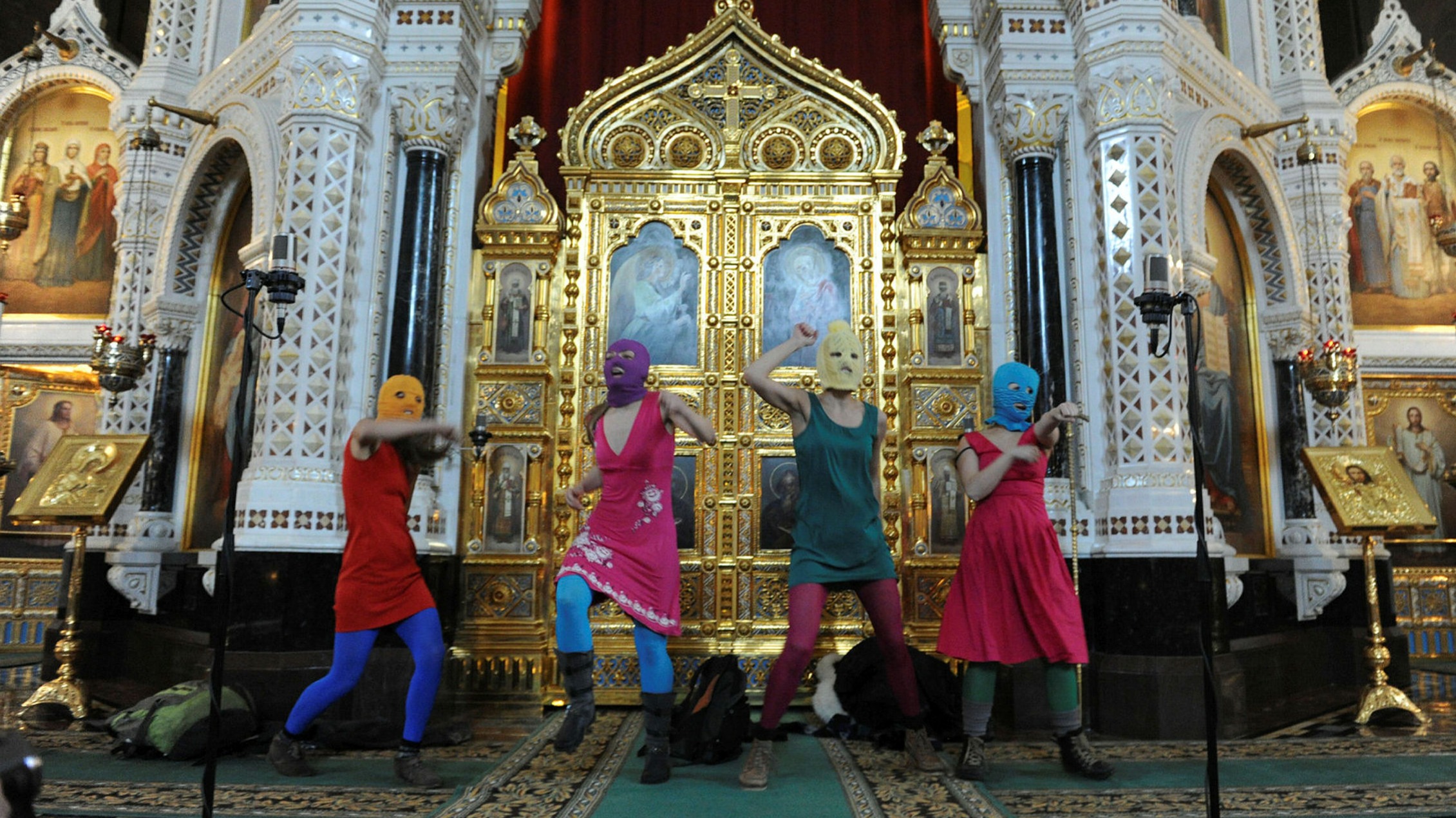
Ten years ago, three members of Pussy Riot stood in the dock of a Moscow court and told the world’s media: “Russia is not as Putin presents it in his daily international meetings.”
The feminist punks were charged with “hooliganism motivated by religious hatred” after staging a musical protest against Putin’s regime in the Russian Orthodox Cathedral of Christ the Saviour in Moscow. In fluorescent dresses and brightly knitted balaclavas, the activists had kicked and punched the air for just under a minute on February 21, 2012, while performing their “Punk Prayer” to an amplified backing track.
Pussy Riot — a collective of around a dozen performers — formed in September 2011, when Russia’s then president, Dmitry Medvedev, proposed that Vladimir Putin — then Russia’s prime minister — stand for the presidency in 2012. “We don’t like the excessive nationalism [Putin] promotes,” they explained in the 2013 documentary, Pussy Riot: A Punk Prayer. “We have an authoritarian regime and we’re not happy about it. It deprives us of our basic right to influence our country’s fate.”
Opposing the patriarchy and crony capitalism and championing LGBTQ rights, they embarked on a series of disruptive — but peaceful — guerrilla gigs. On October 1, 2011, they released their first song, “Kill the Sexist”. The following month they scaled scaffolding and Moscow trolley and subway cars, scattering feathers and warning that “Ballots will be used as toilet paper” in the approaching elections. The regime began to take notice when they performed in Red Square in January 2012.
With “Punk Prayer”, which they performed on February 21 2012, the collective took aim at the Russian Orthodox church. The patriarch Kirill of Moscow had supported Putin’s 2012 re-election, calling him a “miracle from God” who had “rectified the crooked path of history”.
The song opens with a solemn moleban — a supplicatory prayer traditionally delivered by a priest — set to the tune of Sergei Rachmaninov’s “Bogoroditse Devo, Raduisya” (“Ave Maria”), from his 1915 choral piece, All Night Vigil. As translated from the Russian by British poet Carol Rumens, the opening lines are: “Virgin Mary, Mother of God, banish Putin, banish Putin/ Virgin Mary, Mother of God, banish him, we pray thee!”
After that, things get raucous, with battering drums and a distorted guitar line kicking in. Performed in the deeply conservative environment of a Moscow cathedral, in a country with little tradition of punk music, the effect was shocking.
The bawled lyrics draw attention to the way in which Putin’s regime used the church to sanctify nationalist goals: “Congregations genuflect/ Black robes brag gilt epaulettes/ Freedom’s phantom’s gone to heaven/ Gay Pride’s chained and in detention/ KGB’s chief saint descends/ To guide the punks to prison vans.” Later, in an abrupt reprise of the moleban section, the women get on to their knees and pray: “Virgin Mary, Mother of God/ Be a feminist, we pray.”
That August, three Pussy Riot members — Nadezhda Tolokonnikova, Maria Alyokhina and Yekaterina Samutsevich — were convicted and sentenced to two years’ imprisonment. The judge said they had “crudely undermined the social order” and shown a “complete lack of respect” for believers. The trio’s lawyer, Mark Feygin, said: “Under no circumstances will the girls ask for a pardon [from Putin] … They will not beg and humiliate themselves before such a bastard.”
Although the Russian people were largely unsympathetic, Pussy Riot received significant support from the west. Amnesty International designated the women “prisoners of conscience”. At a Moscow concert, Madonna called for the women’s release. Samutsevich was freed on probation in October 2012 but the other two women remained in prison until the end of 2013.
In 2016, Norwegian folk singer Moddi released a haunting cover of “Punk Prayer”, backed by accordion and piano. He filmed the video on the doorstep of the King Oscar II Chapel, which marks the northern border between Norway and Russia. He said: “Pussy Riot were imprisoned for religious hatred, but their performance of ‘Punk Prayer’ never sought to criticise religion. It is telling about the power of the Russian propaganda apparatus when a chorus that goes ‘Holy Mary, drive Putin away!’ can be presented — and even convicted — as blasphemy.”
In various forms, Pussy Riot continue to protest against Putin’s regime. Recently Tolokonnikova reminded readers of Rolling Stone magazine of the high price Russians pay for protesting. “You can easily go to jail for five years just for simply participating in a protest or even for tweeting. I have two criminal cases against me for social media posts. [Governmental punishment] doesn’t require you to go to protests; you just open our mouths on YouTube, Twitter or Instagram. They follow our Instagram stories.” (Though since she said this, social media access has become extremely limited in Russia.)
She also gave a passionate performance of “Punk Prayer” at the New York venue Terminal 5 on February 26. Dressed in fishnets and thigh-high boots, she called for Americans to support Ukrainian sovereignty. “I hate war,” she told the audience. “I love peace. I support Ukraine. Fuck Putin. I hope he dies soon.”
What are your memories of ‘Punk Prayer’? Let us know in the comments section below.
‘The Life of a Song Volume 2: The fascinating stories behind 50 more of the world’s best-loved songs’, edited by David Cheal and Jan Dalley, is published by Brewer’s.
Music credits: Propeller