
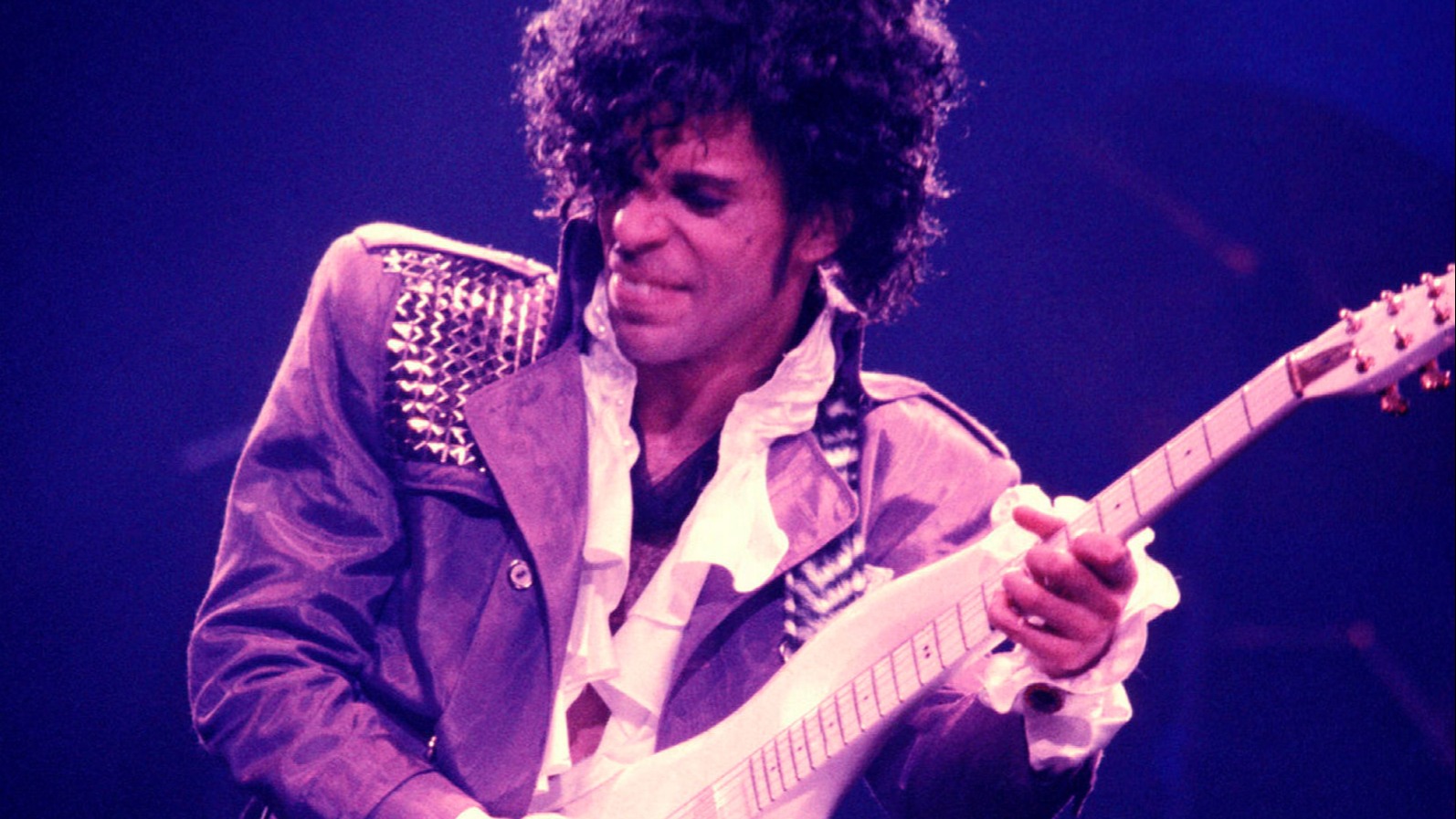
Meteorologically speaking, a downpour of purple rain would probably be quite the ominous portent of some imminent environmental cataclysm. For Prince, who wrote the enigmatic ballad about a violet, violent torrent, the phenomenon, he said, “pertain[ed] to the end of the world … when there’s blood in the sky” — which doesn’t really sound like something people should be bathing in, as the lyrics suggest. But the song would also serve as an augury, not of devastation and culmination, but of Prince’s arrival as a musical force.
Which isn’t to say that “Purple Rain”, released in September 1984, was Prince’s first major breakthrough. His previous album, 1999, garnered widespread critical acclaim and gave him the platform to star in a film — an unabashed career vehicle in which he played an up-and-coming Minneapolis musician. Sound familiar?
But with “Purple Rain”, Prince definitively transcended his reputation as an outré, over-sexed provocateur (see 1980’s uncomfortable paean to incest, “Sister”) who knew his way around a catchy R&B groove. This wasn’t a song engineered to get listeners to dance, but one that would leave them rooted to the spot in the midst of an aural storm of surging vocals, electrified guitar solos and rumbling strings.
The track marked the emergence of Prince as rock royalty, and served as a bold rebuke to his detractors. Three years earlier, he had been subjected to vociferous abuse by a hostile, racist LA crowd, who baulked at seeing a playfully epicene, black performer open for The Rolling Stones. Now here he was delivering an arena hit for the ages: a rock anthem devoid of machismo, a power ballad stripped of schmaltzy histrionics. Pervasive throughout is an almost numinous gospel spirit, one that dismantled any false dichotomies between “black” soul music and “white” guitar-led rock.
Yet “Purple Rain” was initially conceived as a country-inflected duet with Fleetwood Mac’s Stevie Nicks, who turned it down, claiming Prince’s vision for the song was “too much” for her. All that’s left of its country origins is its evocative title — which Prince lifted from the song “Ventura Highway” by the folk-rock group America, of anonymous-horse riding fame.
The transition from country to atmospheric stadium rock wasn’t instigated by Prince himself, but by Wendy Melvoin, the 19-year-old guitarist in his backing band, The Revolution. During rehearsals, she hit upon the indelible opening chords, inspiring Prince to take the song in a completely different direction. After six hours of non-stop practice and experimentation, “Purple Rain” was all but written.
The song’s recording was a similarly intense and spontaneous affair. The version of the track that made it on to the album was in fact the first time Prince ever played it for an audience — and the first time Melvoin performed live with the band. On a sweltering Minneapolis night, the crowd at a local benefit concert stood in a hushed reverence throughout the song’s 13 minutes (a third verse was later cut in one of only a few post-production edits), perhaps recognising that they were witnessing a piece of pop history. The performance was later recreated and mythologised as the climactic scene in Prince’s film, which would fittingly end up being called Purple Rain.
After Prince, a deluge of “Purple Rain” covers. Etta James, Gregory Porter and Kwaye mined the soulful undercurrents of the original in their smooth, honeyed versions, while London Grammar took a similarly pared-back approach in their cool, crystalline rendition. Other pop singers such as Kelly Clarkson, Jessie J and Celine Dion instead chose to make the most of the song’s lung-busting potential. Though not quite so vocally supple as the above, Bruce Springsteen’s effort didn’t lack emotive resonance in his live tribute following Prince’s death in 2016.
Elsewhere, guitar heroes Eric Clapton and Jeff Beck picked up the gauntlet left by Prince with his searing solos, while Adam Levine unexpectedly proved that he’s also a nimble axe-wielder when he’s not busy committing musical atrocities with Maroon 5. Dwight Yoakam meanwhile finally brought “Purple Rain” back to its country origins with his jaunty bluegrass iteration.
For Prince, imitation was less a sign of flattery than a kind of existential threat; he once said that “covering the music means that your version doesn’t exist any more.” But nobody watching his later-career-defining 2007 Super Bowl halftime show could begin to imagine that “Purple Rain” belonged to anyone else. Drenched in a sudden downpour and bathed in lurid lighting, he found himself underneath the purple rain, a performer at the peak of his powers. Nobody would have even questioned it in that instant if he’d have claimed to have organised the weather himself.
What are your memories of ‘Purple Rain’? Let us know in the comments below.
‘The Life of a Song Volume 2: The stories behind 50 more of the world’s best-loved songs’, edited by David Cheal and Jan Dalley, is published by Brewer’s
Music credits: Rhino/Warner Records; RCA Victor; Mahogany Sessions; Rhino; Concord Sugar Hill
Picture credit: Richard E. Aaron/Redferns