
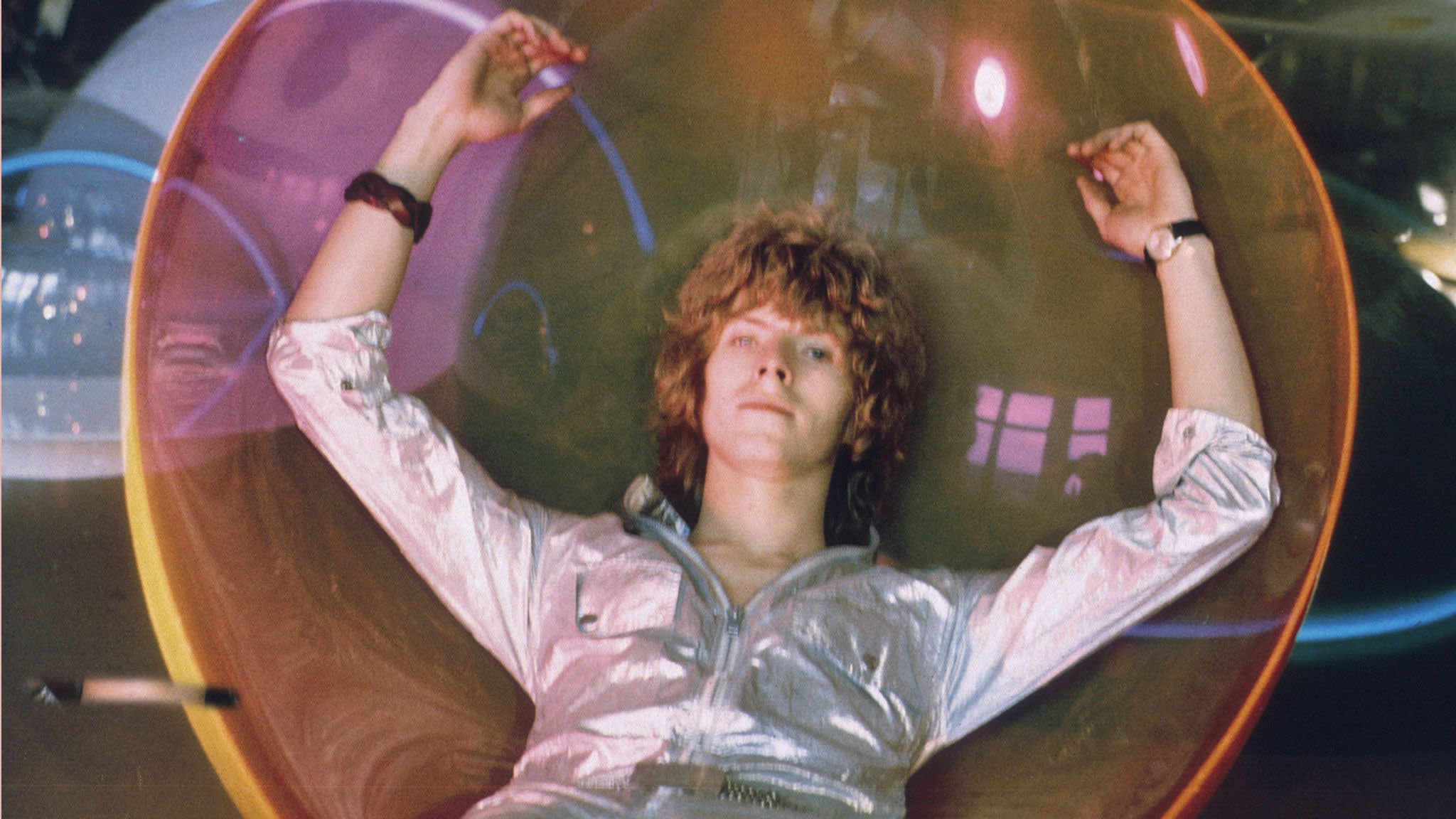
In 1968, after numerous flop records, David Bowie still seemed light-years away from the breakthrough he craved. But Stanley Kubrick’s film of that year, 2001: A Space Odyssey, which Bowie watched, he later said, while “out of my gourd” (he wasn’t the only one), provided the trigger. The film helped Bowie find his metier as pop’s alienated alien, his heterochromic eyes casting a regretful gaze across the human planet and finding it wanting.
Bowie, reputedly lovelorn from splitting up with his girlfriend Hermione Farthingale, composed a wistful sci-fi ballad called “Space Oddity”. He recorded several demo versions with his then-collaborator, guitarist John Hutchinson, some of which featured a Stylophone, a new, buzzing, semi-musical instrument. Played with a pen-like stylus, the Stylophone seemed futuristic but was sold in Woolworth, which somehow suited Bowie’s song. His cosmic adventures could be understood at ground level; thrilling and awe-inspiring, but small-scale, suggesting that even in space, humans had feet of clay.
Bowie’s label, Philips, earmarked ‟Space Oddity” as a single. By the time it was due for release, the Apollo 11 mission to the Moon was front-page news. Initially, this was a problem, because Bowie’s new producer, Tony Visconti, thought the song was ‟a gimmick to cash in on the Moonshot”. Gus Dudgeon, the sound engineer who worked with Visconti, strongly disagreed, and was installed as the single’s producer. He had limited experience as a producer, but ‟Space Oddity” would make his name, as it would for Bowie, transforming Dudgeon into one of the 1970s’ most respected producers, with credits including Elton John’s similarly downbeat cosmonaut ditty, “Rocket Man”.
Bowie recorded ‟Space Oddity” at London’s Trident studios on June 20 1969. The finished track matched Stylophone against the upmarket Mellotron, played by future prog star Rick Wakeman. The single was released on July 11, nine days before Apollo 11’s module Eagle disgorged Neil Armstrong and Buzz Aldrin on to the lunar dust. The song’s Major Tom, plaintively asking Ground Control to tell his wife “I love her very much” from “a tin can” in the great void, had seen through the glory of space travel. Though this downbeat mood marked a sharp contrast to the hullabaloo around the lunar landing, Bowie’s record soared to number five in the UK. BBC radio did not feature it until Apollo’s crew had returned to Earth, though it was used to soundtrack some TV repeats of the landing.
Bowie had found his hit at last, but it wasn’t until he invented another enigmatic cosmic traveller in 1972’s ‟Starman” that he returned to the singles chart. ‟Space Oddity”, however, was not done: reissued in 1973, it became his first US top 20 single. The record topped the UK chart on re-release in 1975.
In 1970, Bowie voiced a version with romantic Italian lyrics, “Ragazzo Solo, Ragazza Sola” (“Alone Boy, Alone Girl”). He issued a new acoustic interpretation of ‟Space Oddity” in 1980, and live recordings have surfaced down the decades, as have the spartan, atmospheric demos. Cover versions took some time to appear, probably because the song was strongly stamped with Bowie’s personality. Comedy group The Barron Knights snickered a feline parody in 1977 (“Birth control to Ginger Tom”), but from this point on, the song was treated reverentially. Most covers tightly followed the blueprint of the original, including Def Leppard’s, and versions by very different German bands, Helloween and Tangerine Dream. One exception to the Xerox treatment came from US jazz-fusion arranger Dave Matthews, whose 1977 take was at least different if not entirely convincing, breaking with convention by being sung by a woman, Googie Coppola. Natalie Merchant included the song on a live album in 1999.
Though ‟Space Oddity” cut Major Tom adrift, he enjoyed an impressive afterlife. Bowie revisited the character in “Ashes To Ashes” (1980), depicting the astronaut as a junkie, echoing his own troubles. 1995’s ‟Hallo Spaceboy” saw some of the lyrics rehashed at the prompting of collaborators Pet Shop Boys, and what is assumed to be Major Tom’s corpse took a grim curtain call in the video for ‟Blackstar” (2016).
In 1983 electro-popper Peter Schilling had a hit with “Major Tom (Coming Home)”, its hapless protagonist suffering another mishap. Canadian electronic artist K.I.A. offered ‟Mrs Major Tom” in 2002, with singer Larissa Gomes recounting the yarn from the wife’s point of view. This was covered by Sheryl Crow on William Shatner’s Seeking Major Tom, a 2011 album which also included the Star Trek actor’s clunky reading of ‟Space Oddity”.
Perhaps inevitably, the Major actually travelled into space when Canadian astronaut Chris Hadfield sang ‟Space Oddity” on the International Space Station in May 2013. Careful not to tempt fate, Commander Hadfield amended the lyrics so Major Tom finally made it home. Though the video caused consternation for lawyers (was a song performed in orbit subject to terrestrial copyright?), Bowie was delighted, declaring it ‟possibly the most poignant version”.
What are your memories of ‘Space Oddity’? Let us know in the comments section below.
‘The Life of a Song Volume 2: The fascinating stories behind 50 more of the world’s best-loved songs’, edited by David Cheal and Jan Dalley, is published by Brewer’s.
Music credits: EMI UK; Virgin EMI; Parlophone UK; Castle Communications; Cleopatra Records; Epic/Legacy; Elektra Records; Peer Southern Productions Germany; Neuphoria Recordings
Picture credit: David Bebbington/Retna