
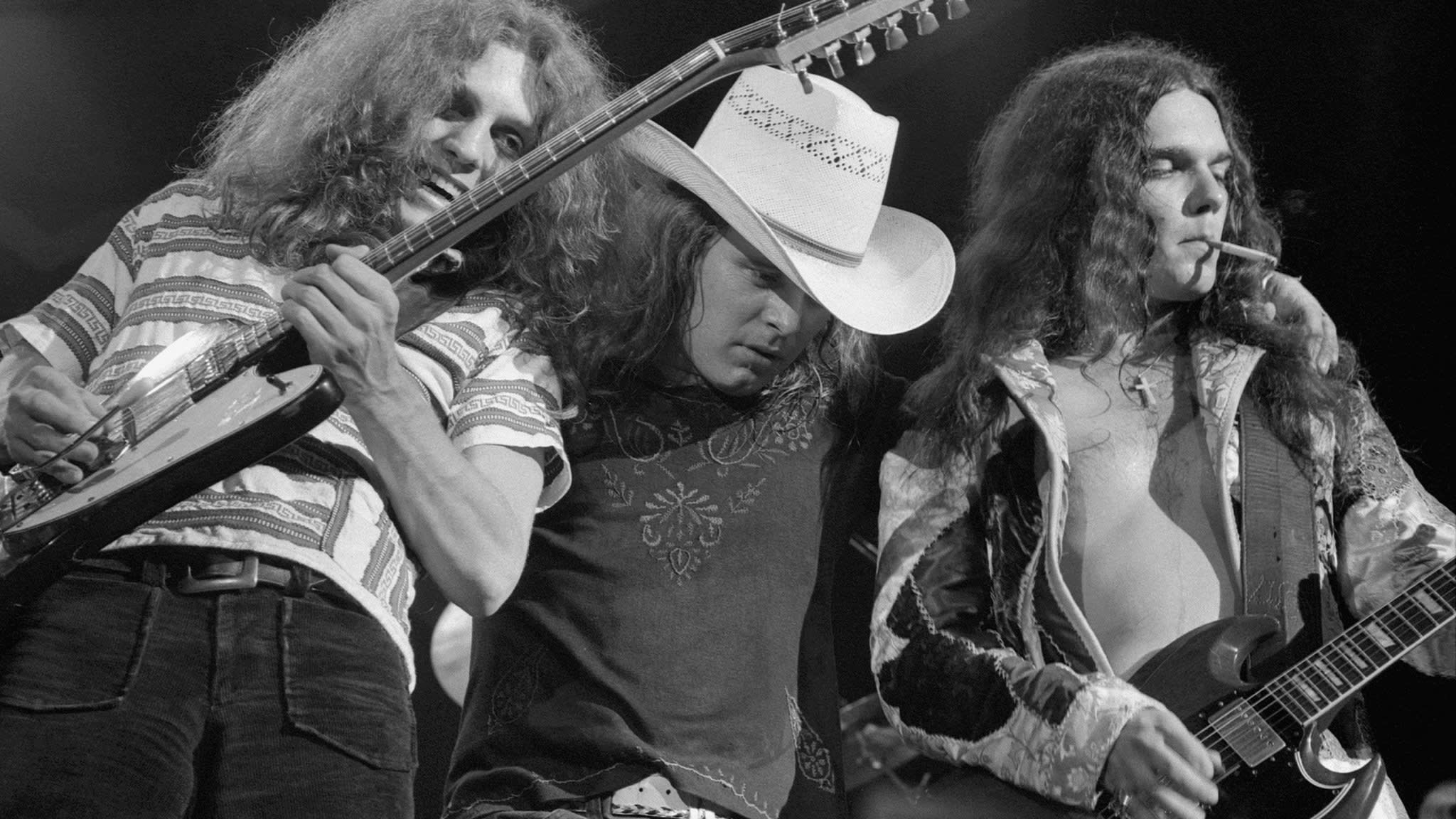
As the surviving members of Lynyrd Skynyrd swagger through their farewell tour this summer and autumn, they will end each concert with their two greatest hits: “Free Bird” (the most requested song in rock history) and the southern rock anthem “Sweet Home Alabama”.With an opening riff that practically pours you a shot of bourbon, slaps a Stetson on your head and drags you on to the dancefloor, it’s a perfect, five-minute distillation of the contradictions of the American South: easy-going and defiant, dark and elated, macho and silly, proud and defensive, excessive and simple, direct and slippery.
Released in 1974, the song was written one larky afternoon in the tin-roofed Floridan cabin nicknamed “Hell House” where the band sweated out most of the material for their first two albums. Guitarist Ed King said the riff came to him in a dream the night before. Frontman Ronnie Van Zant began improvising a jokey, lyrical response to Neil Young’s attacks on southern racism in songs “Southern Man” (1970) and “Alabama” (1972). “Well I hope Neil Young will remember/ A southern man don’t need him around anyhow…”
Does that mean that the band (who took their name from a high school gym teacher, Leonard Skinner, who disapproved of their long hair) were supporters of southern segregation? Neo-Nazi group Skrewdriver certainly believed so, pledging allegiance to the Ku Klux Klan in a 1980s version. But though Van Zant sings about how the people of Birmingham, Alabama, love their pro-segregation governor (George Wallace), the line is followed by the band jeering: “Boo! Boo! Boo!”
Van Zant went on to ask Young if, as a northerner (actually a Canadian), he should feel as personally responsible for the Watergate scandal as he was telling all southerners to feel about the policies of Wallace. In 2012, Young acknowledged that he “richly deserved the shot Lynyrd Skynyrd gave me” and went on to wear a Skynyrd T-shirt on stage while Van Zant wore Young merchandise. A few weeks after Van Zant and several other members of the group were killed in a 1977 plane crash, Young performed “Sweet Home Alabama” at a gig in Miami.
He would prove the first of many drawn to the song, which has been covered live by everyone from California punks Green Day to Barbadian pop star Rihanna. Alaska-raised singer songwriter Jewelrecorded a pouty version for the soundtrack of 2002 romantic comedy named after the song and starring Reese Witherspoon as a woman rediscovering her southern roots.
Most artists serve it up straight at southern shows, although Nirvana mocked its seventies strut with a mumbled version on their 1993 MTV Unplugged album and Gallic crooner Johnny Hallyday delivered an unintentionally hilarious French take in 1982. Parodies include “Sweet Home South Korea”, whose lyrics run: “Well I hope Kim Jong will remember/ South Korea don’t need him around, anyhow.”
Rappers have regularly sampled the riff. Houston’s Geto Boys spat misogyny over it on 1988’s “Gangsta of Love” while Eminem delivered a comic version over his broken-down car in the 2002 biopic 8 Mile. Most recently Michigan’s Kid Rockmashed it up with another 1970s hit — Warren Zevon’s “Werewolves of London” — as the backdrop to his nostalgic single “All Summer Long”, which toppled Dizzee Rascal’s “Dance Wiv Me” from the top of the UK chart in 2008. Rock’s lyrics find him nostalgic for the summer of 1989 when he was “smoking funny things/ Making love out by the lake to our favourite song… Singing ‘Sweet Home Alabama’ all summer long.”
A vocal Trump supporter, who recently declared an ambition to run for the US Senate, Kid Rock will appear as a special guest at an undisclosed date on Lynyrd Skynyrd’s last tour. On August 31 the band (now fronted by Ronnie Van Zant's younger brother Johnny) will play the Oak Mountain Amphitheatre in Alabama: a state where the skies are still blue, and the people still vote red.
We’re keen to hear from our readers. What are your views on ‘Sweet Home Alabama’? Let us know in the comments below
‘The Life of a Song: The fascinating stories behind 50 of the world’s best-loved songs’, edited by David Cheal and Jan Dalley, is published by Brewer’s
Music credits: Universal-Island Records Ltd, Hollywood (Europe), Top Dog/Atlantic
Picture credit: Leonard M. DeLessio/Corbis via Getty Images