
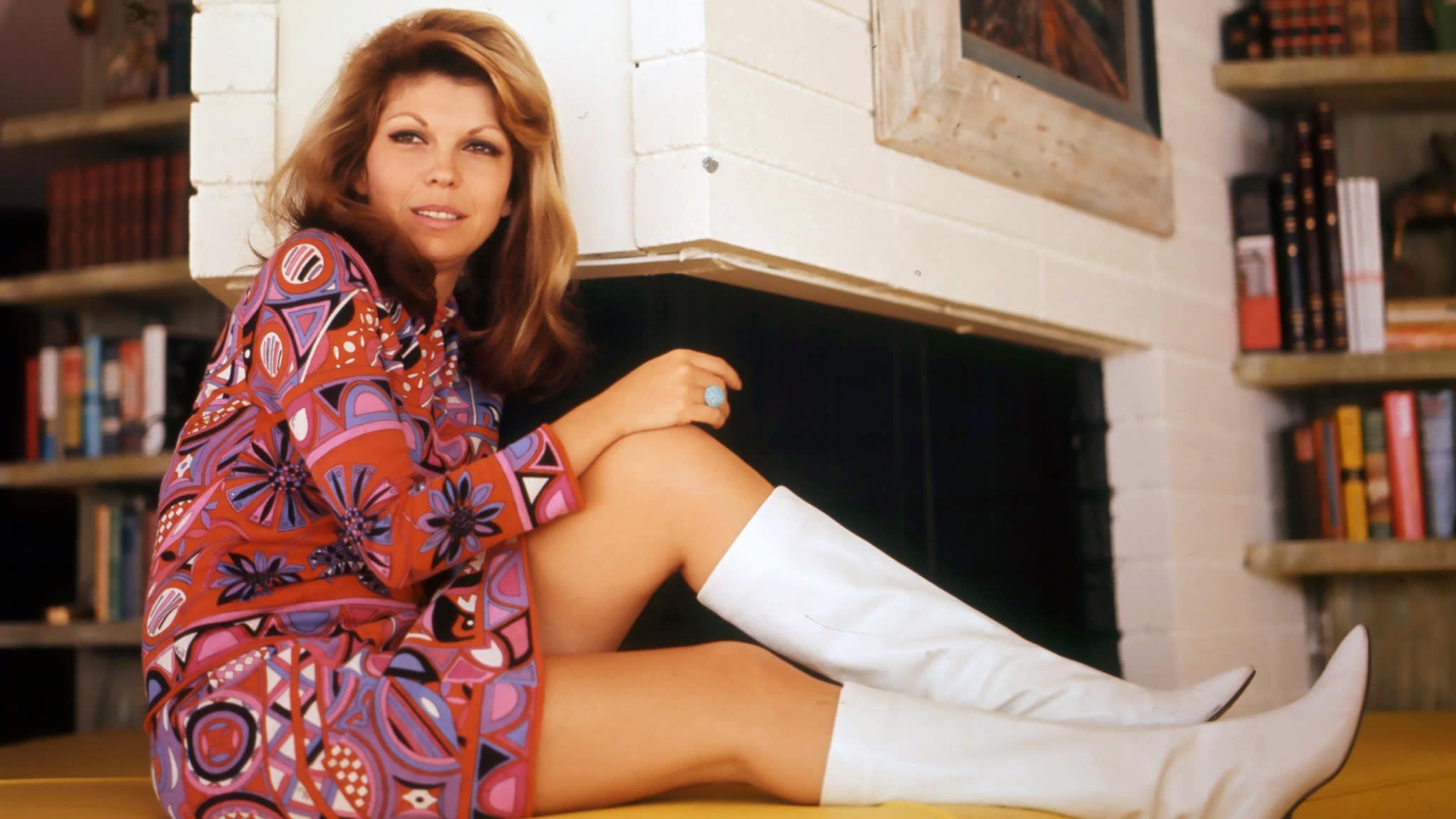
The 1960s had a thing for boots, which occasionally erupted into song. Patrick Macnee and Honor Blackman, stars of The Avengers, babbled a breathless homage to “Kinky Boots”. Soul group The Orlons lamented “Them Terrible Boots”, and mod band The Artwoods confessed “I’m Looking for a Saxophonist Doubling French Horn Wearing Size 37 Boots”. But the decade’s dominatrix of leather zip-ups was Nancy Sinatra, whose “These Boots Are Made for Walkin’”took pop to places it had previously only fantasised about. This oddball song was a tough-talkin’, heavy-stridin’, even fetishistic assertion of grrrl power — and Nancy’s father approved of it.
Nancy Sinatra in calf-high scarlet patent is as much a part of 1960s iconography as Ronnie Spector’s beehive hairdo and Julie Driscoll’s cheekbones, but the celebrity status of Frank Sinatra’s boot-wearing daughter was never a shoo-in. Nancy had dropped out of stage school, appeared in lousy teen movies (The Ghost in the Invisible Bikini), and had released 11 singles. All flopped, but this did not deter her record label, Reprise — perhaps because her father owned it. But it bothered Frank that the pop-buying public ignored Nancy’s records, and he told Jimmy Bowen, Reprise’s A&R executive, to find her a hit. Bowen turned to Lee Hazlewood, a singer-songwriter who had produced Duane Eddy. Hazlewood was sceptical, but agreed to meet Nancy at her mother’s Hollywood home. They were engaged in small talk when Sinatra père arrived and expressed his delight that Hazlewood was working with his daughter. You didn’t argue with Frank.
Days later, Hazlewood was in the same room auditioning songs for Nancy. Frank, apparently disinterested, sat reading a newspaper. One tune caught Nancy’s fancy. Hazlewood told her it “wasn’t really a girl’s song” but the singer disagreed. A guy walking over a girl sounded abusive, she said, but delivered by a woman, it would take on an entirely different slant. When Hazlewood had left, Sinatra Sr, not fazed by its strange subject, announced: “The song about the boots is best.”
Nancy had always sung with a “girly” voice, but at rehearsals, Hazlewood told her to “sing like a 16-year-old who f**** truck drivers”. Nancy grinned, “I can do that,” surely relieved that someone connected with her recording career had decided that daddy’s little girl, then 25, had at least reached the age of consent — in some states.
The session’s hired hands included Chuck Berghofer, who played the tumbling double bass line that helped shape the record’s character: it sounded slack and sarcastic. This matched Nancy’s disdainful vocal, delivering lyrics that made her sound like a pyromaniac as well as an ass-kicker. Another masterstroke was a go-go climax, launched by Nancy’s command: “Are you ready boots? Start walkin.’”“These Boots Are Made for Walkin’”, released in February 1966, strolled to number one in the US, UK, Canada and Australia. Nancy charted again, duetted with Hazlewood and her father, and sang the theme for You Only Live Twice. Meanwhile, “These Boots Are Made for Walkin’” marched on.
Hazlewood’s own recording of the songfeatured commentary suggesting that the arranger of Ms Sinatra’s version, Billy Strange, considered it too strong; nevertheless, Strange released his own take. Ella Fitzgerald’sinterpretation began as if it was about shoe shopping, and The Artwoods added it to their footwear repertoire. Reggae group Symarip replaced “walkin’” with “stomping” to match the 1970 skinhead moonstomp dance craze. TV presenter Paula Yates “sang” it in 1982 with British Electric Foundation.
Three years later, thrash-metal band Megadethmade the lyrics more explicit and incurred Hazlewood’s wrath; perhaps he had forgotten his singing advice for Nancy. German industrial act KMFDM cut three versions for a single. Geri Halliwell, Jessica Simpson and Lil’ Kim all covered it, drawing girl power inspiration from Ms Sinatra’s definitive performance of “These Boots Are Made for Walkin’”.
We’re keen to hear from our readers. What are your memories of ‘These Boots Are Made for Walkin’’? Let us know in the comments below.
‘The Life of a Song: The fascinating stories behind 50 of the world’s best-loved songs’, edited by David Cheal and Jan Dalley, is published by Brewer’s.
Music credits: Boots Enterprises, Inc; The Dave Cash Collection — OMP; Jazzman; Capitol Catalog
Picture credit: Alamy