
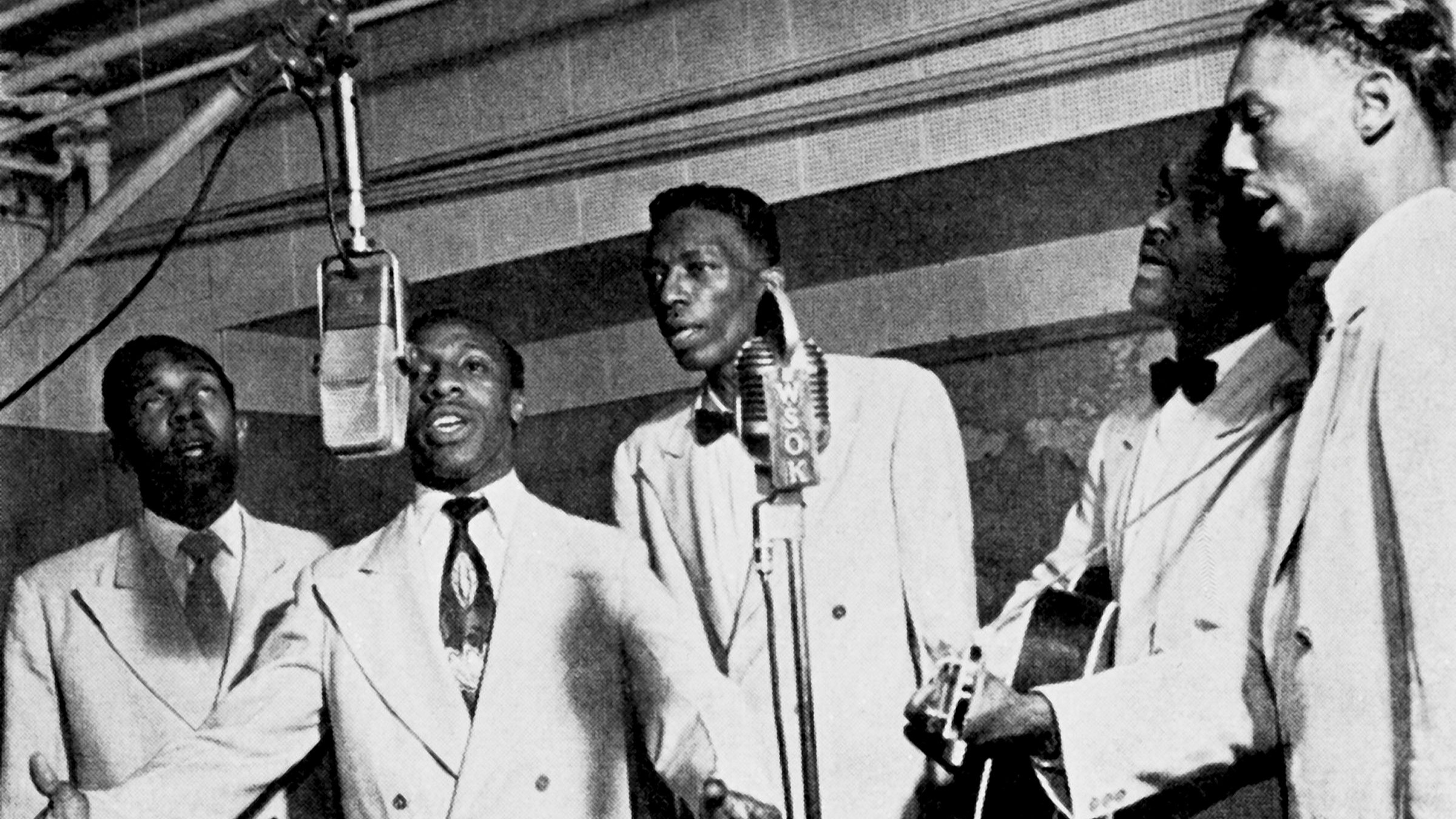
What links a posse of hardened criminals from Tennessee with the best man at Judy Garland’s fifth wedding? Answer: a song wreathed in myth, infused with a sense of yearning born of its author’s lengthy incarceration in the state penitentiary.
Johnny Bragg had not had much luck when he penned “Just Walkin’ in the Rain” in 1952. His birth, in the poor black side of Nashville around 1925, killed his mother. Some accounts say he was delivered blind, regaining his sight at the age of six. He had been in jail before he was arrested on a rape charge in 1943 — an accusation by his girlfriend that she later withdrew, but not soon enough for the cops to pin five more unsolveds on him, one of which involved a white woman. He was 10 years into a 594-year sentence when, crossing the prison yard under gloomy skies, he remarked to fellow inmate Robert Riley: “Here we are, just walking in the rain, wondering what the girls are doing.”
Riley suggested that it would make a good song. Bragg’s musical talents were unquestionable — one of the legends about him is that he sold “Your Cheatin’ Heart” to Hank Williams for $5 after the country star played a prison concert. Bragg couldn’t read or write, so he gave Riley co-authorship for his transcription.
This act of creation seemed to change his fate. State governor Frank Clement believed in rehabilitation. Under his reforms, Bragg formed a group to sing for condemned prisoners. His Prisonaires comprised Ed Thurman and William Stewart (each doing 99 years for murder), John Drue Jr (three for larceny) and Marcell Sanders (one-to-five for involuntary manslaughter). When local radio producer Joe Calloway had them sing for a broadcast, he knew who to call — Sam Phillips.
The Sun Records supremo had the band transported under armed guard to his studio in Memphis, where the original recording,a soulful lament in the vein of The Ink Spots, was cut. Watching from the wings, another story goes, was a young hillbilly named Elvis Presley. Released in 1953, it would sell 250,000 copies and earn Bragg parole.
Johnnie Ray’sJuly 1956 version of “Just Walkin’ in the Rain” sold eight times more. A shy farm boy from Oregon, John Alvin Ray (1927-90) taught himself to play hymns on his parents’ organ at the age of three. Rendered half deaf in an accident at 13, he found salvation in his sister’s Billie Holiday records. He honed his emotive performance style — in which he routinely burst into tears — at The Flame Showbar, a black club in Detroit. Spotted by Columbia, he shot to the top of the US charts for 11 weeks in 1951 with his single “Cry”. Ray inspired hysteria in audiences not seen since Frank Sinatra’s fainting, screaming bobby-soxers of the 1940s — a phenomenon not confined to America. When Ray first arrived in the UK in 1954, crash barriers were installed at the airport to protect the “Prince of Wails” from his adoring hordes.
Ray’s version of “Just Walkin’ in the Rain” added a catchy whistle and backing from The Ray Conniff Singers. It floated to the top of the British charts, where it hung for seven weeks. Yet Ray was not a fan of the song; he’d had to be persuaded to record it by his A&R man, Mitch Miller. Surprising, given his grounding in gospel and R&B.
Ray later turned his back on the music he helped father. He was tormented by his deafness and closet bisexuality, and his judgment was clouded by booze and pills. Dropped by his label in 1960, he never recorded again, though he was not forgotten in Britain, where he continued to play residencies and the supporting role to his equally troubled friend Judy Garland, when she married Mickey Devinko at Chelsea Old Town Hall in March 1969. Three months later, worn out by substance and emotional abuse, Garland was dead, aged 47. Ray had been on the wagon for more than a decade but hit the bottle again soon after, checking out of this world from liver failure at 63.
Though his sentence was commuted and his new band, The Marigolds, signed to Decca, the law still lay in wait for Johnny Bragg. He was arrested for “parole violation” in 1960 after being found in the back of a car with a white woman. Never mind that she was his wife — Bragg was back in the slammer for six more years.
He put together another Prisonaires line-up after his release, but they never recorded. Bragg worked in a cemetery until his death from cancer in 2004. He enjoyed a few royalties more from Jim Reeves,Eric Clapton & The Impressions and Shakin’ Stevens, who all recorded very different versions of his song — mariachi-flavoured country, glossy soul and Elvis impersonator rockabilly respectively. But it’s the original, Sun-recorded doo-wop masterpiece that remains its most hauntingly effective setting.
What are your memories of ‘Just Walkin’ in the Rain’? Let us know in the comments section below.
‘The Life of a Song Volume 2: The fascinating stories behind 50 more of the world’s best-loved songs’, edited by David Cheal and Jan Dalley, is published by Brewer’s.
Music credits: 24 Blue Music; FM Records; RCA Records Label
Picture credit: Michael Ochs Archives/Getty Images