
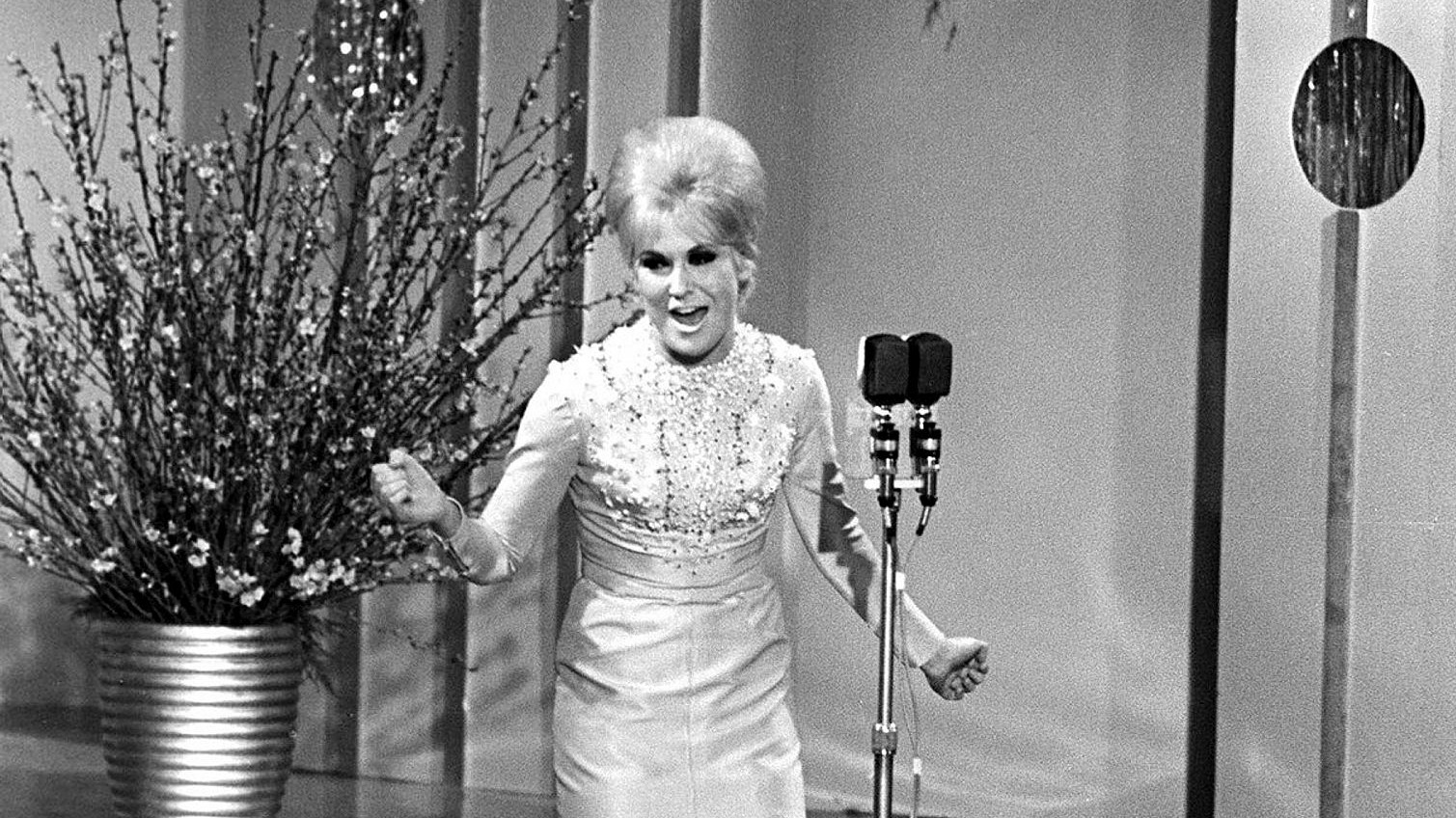
In keeping with her eventful and turbulent life, Dusty Springfield’s 1966 hit “You Don’t Have to Say You Love Me” was a dramatic, febrile tour de force of passion and self-sacrifice, and a song with a rich history. In January 1965, Springfield — who was by then a familiar figure in the pop charts in the UK and the US — flew to the Mediterranean coast of Italy for the Sanremo Music Festival. This annual event, whose format had in the 1950s been adapted as the basis for the Eurovision Song Contest, was a glitzy, prestigious affair, and the English singer (born Mary O’Brien) was honoured to be invited.
Singing two songs in Italian, in a contest that included stars such as Connie Francis and Gene Pitney, she failed to reach the final stages. However, Springfield was an attentive student of music, often sitting with a notepad to watch other acts, so she stayed and observed. One performance in particular captivated her: “Io che non vivo (senza te)” (“I, Who Can’t Live Without You”), an epic love song in three-four time written by Pino Donaggio and Vito Pallavicini.
Under the rules, and because this was a festival about songs more than about singers, each song was sung by two different artists, in this case Donaggio and American singer Jody Miller (in a different, string-based arrangement). It was Donaggio’s rendition that captured Springfield: in a blaring arrangement that was to become familiar, he performed with high emotion (and showed off his extraordinarily expressive eyebrows). “It moved me to tears,” Springfield later said. She returned to London with an acetate, determined to record her own version.
It was some time before her wish came to fruition. First, a backing track was recorded, very much in the style of Donaggio’s original: big, bold and brassy. But there was no translation of the lyrics. A friend of Springfield’s, Vicki Wickham, a producer on the TV show Ready Steady Go! (later to become Springfield’s manager), and Wickham’s friend Simon Napier-Bell (later manager of Wham!), neither of whom had any experience of songwriting, were game. They hurriedly came up with what they initially hoped would be an anti-love song, “You Don’t Have to Love Me”, though this didn’t scan, so they expanded the line to fit the music.
In the studio Springfield made 47 attempts at her vocal, eventually decamping to a stairwell to get the right acoustic and delivering a matchless performance, stretching and stuttering the lyrics. In March 1966 it was released and shot to number one in the UK and number four in the US, becoming her biggest hit and her signature song. Napier-Bell later said that the lyric reflected the “swinging” London of one-night stands and the early days of the pill, but Springfield’s heartfelt performance took it to another level.
Quickly it was taken up by other artists, including Brenda Lee (steely) and Cher (twangly, guitar-driven; both 1966). Was it possible to make this enormous song bigger still? It was, and Elvis Presley achieved it in 1970 in a quaking, tremulous rendition that became a worldwide hit.
Meanwhile “Io che non vivo (senza te)” had a life of its own, with hundreds of versions, as well as an instrumental, “Jamais je ne pourrai vivre sans toi”, by French easy-listening orchestra leader Raymond Lefèvre et son grand orchestre (1965). Patrizio Buanne’s 2006 version alternated between Italian and English.
Most covers of “You Don’t Have to Say You Love Me” have followed the Donaggio/Springfield template. But in 1998 reggae legend John Holt stripped it down in a heartfelt reading under the title “You Don’t Have to Say”. Another relatively recent cover broke the mould: American singer Shelby Lynne’s 2008 recording from her Springfield tribute album Just a Little Lovin’ is refreshingly restrained, featuring acoustic guitar, brushed drums, a more conversational vocal delivery — and no key change.
The Sanremo festival is still held annually (this year’s takes place on February 1-5), with the winners going on to represent Italy in the Eurovision Song Contest. There were periods when Italy didn’t bother with Eurovision, with broadcasters saying that it attracted little domestic interest — but the country has re-embraced the event and last year triumphed with the heavy rock “Zitti e buoni” from Måneskin (which means that this year’s festival will take place in Turin) — a million miles from the balladry of Donaggio. Meanwhile Donaggio, now 80, went on to become a composer of film scores; his credits include Nicolas Roeg’s Don’t Look Now and several Brian De Palma films, including Carrie.
Springfield died in 1999, having experienced a career revival with her 1990 album Reputation, with five songs produced by the Pet Shop Boys. She was somewhat dismissive of a track whose histrionic amplitude contrasted with the American styles (initially folk and country, later soul and gospel) that she favoured on albums such as her classic Dusty in Memphis. “Good old schmaltz,” she called it.
What are your memories of ‘You Don’t Have to Say You Love Me’? Let us know in the comments section below.
‘The Life of a Song Volume 2: The fascinating stories behind 50 more of the world’s best-loved songs’, edited by David Cheal and Jan Dalley, is published by Brewer’s.
Music credits: Spectrum; Columbia; Rainer Kern; Import; Sony; Riviera; Phoenix Music International; Lost Highway